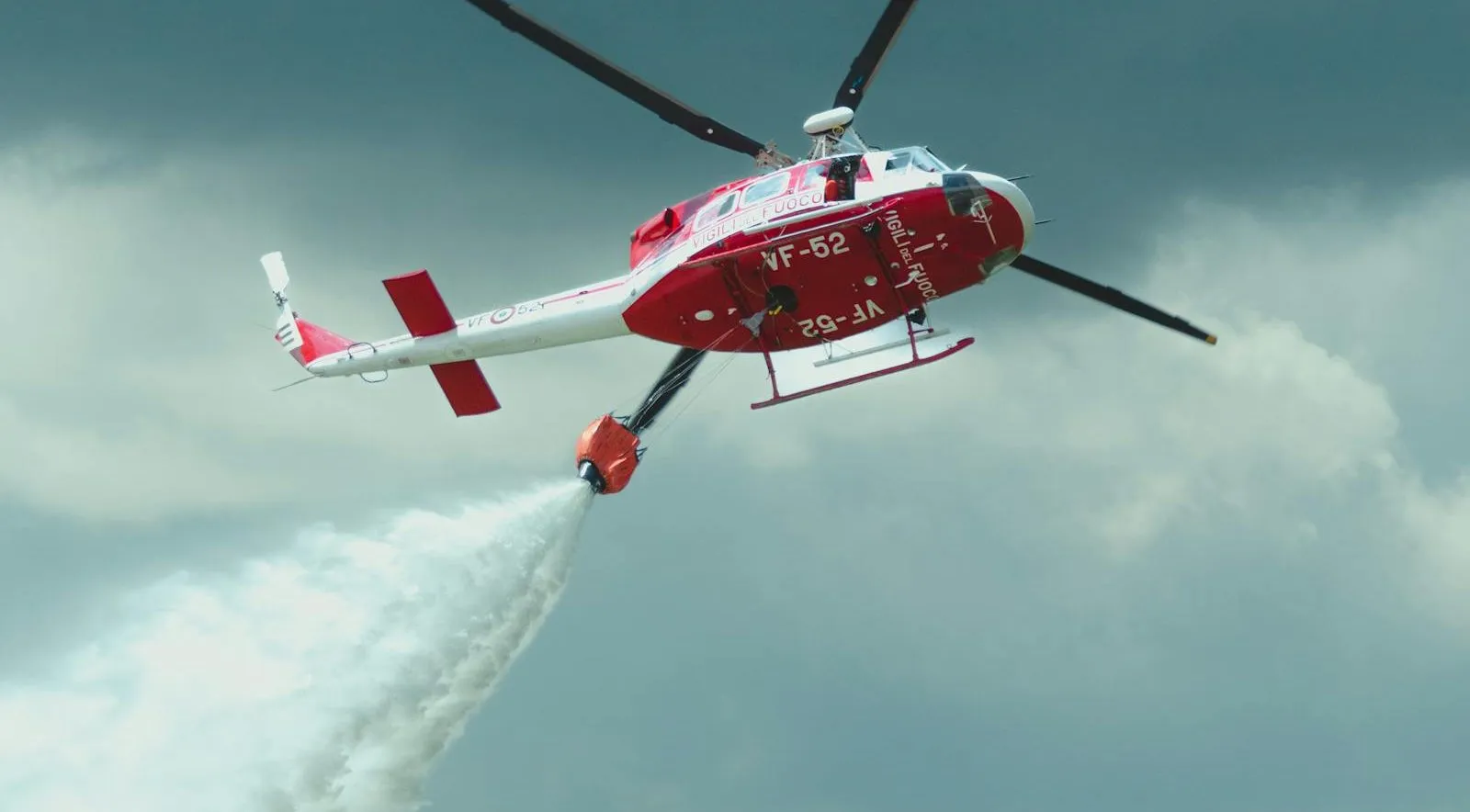
International firefighting cooperation has always rested on a foundational assumption that is rarely stated out loud. Fire seasons in different regions of the world do not fully overlap, so countries in the Northern and Southern Hemispheres can share aircraft and crews, along with the supporting equipment, across the calendar. Canadian air tankers fly south to Australia in November. Australian strike teams fly north to Canada and the western United States in July. Aerial fleets cycle between continents. Training and certification are harmonised partly so that the movement of personnel across borders happens smoothly, and the financial model of several of the larger aerial firefighting companies assumes roughly this seasonal rotation as a baseline for cost recovery. The whole architecture is built for sequential demand.
New research published in early April 2026 is showing that this foundational assumption is measurably breaking down. A Nature portfolio paper on human-induced climate change and spatially compounding fire weather extremes in Europe finds that the geographic extent of simultaneous extreme fire weather across Europe has expanded by nearly 15 per cent annually over the past decade, driven by rising temperatures and declining humidity (Human-induced climate change intensifies spatially compounding fire weather extremes, 2026). The paper describes fire weather becoming more frequent and covering larger areas, while also arriving earlier and ending later in the season than the historical baselines assumed. These are projections about the next decade, not the end of the century, and they align with the 2025 European fire season – more than 1.08 million hectares burned in the EU alone and a record-breaking total of 2.24 million hectares when Middle Eastern and North African fires are added – as a reality check on the pace of change.
This work complements the Yin et al. Science Advances paper I cited in a separate article on fire weather attribution. Where Yin and colleagues documented the global trend toward synchronous extreme fire weather at planetary scale (with more than a twofold increase in synchronous fire weather in most regions since 1979), the April 2026 European paper sharpens the regional picture and gives it specific operational projections. Between them, the two papers describe a world where the sequential assumption in the resource-sharing model is no longer reliable, and where the breakdown is concentrated in the specific weeks where strike teams and aerial assets would traditionally be moving between hemispheres.
Australia felt a version of this during the 2019-20 Black Summer. Northern Hemisphere resources were less available than pre-season coordination had assumed, because the North American fire season had run long and the European season had overlapped more than planners expected. In the years since, the direction of travel has been consistent. The North American fire seasons in 2021 through 2025 have increasingly overlapped with the Australian season. Canadian British Columbia Wildfire Service personnel deployed into Victoria during January and February 2026 to support the response, which is the most recent example of the kind of inter-jurisdictional aid that still does happen when the overlap is partial. But the margin is getting thinner every year, and the planners who run the coordination arrangements are increasingly working in an environment where the underlying seasonal assumption no longer holds.
If concurrent fire weather continues to become the norm rather than the exception, the implications for how Australia sizes its own fleet and workforce are not subtle. Mutual aid agreements built on sequential demand stop working when everyone needs the same aircraft and crews at the same time. Aerial fleet sizing has to be rethought, because the contracting model that assumed access to imported capability during the worst weeks will no longer be reliable. Workforce planning has to adjust, because the assumption that experienced crews from one jurisdiction can be called on when another jurisdiction needs them depends on those crews being available. Financial exposure grows as well. The insurance markets underwriting some of the equipment movement (along with the reinsurance layer behind them) are reading the same data and are likely to reprice that risk, a dynamic I wrote about separately in the context of the widening protection gap.
Better prediction is part of the adaptive response, and there is some genuinely promising work in train. A new Australian product, developed using Sentinel-2 satellite imagery, delivers live fuel moisture content at around 20-metre spatial resolution (CSIRO, 2026). That is a substantial leap from the 500-metre MODIS baseline that Australian agencies have been using, because live fuel moisture is one of the more important predictors of fire spread and one of the harder variables to measure accurately at useful scales. Better fuel moisture data sharpens fire spread modelling, which matters for real-time suppression decisions. It also improves prescribed burn planning, which matters for fuel management between seasons. Both of these are concrete operational benefits, and both are more valuable in a world of more concurrent fire weather because they give land managers a stronger basis for prioritising the limited resources they have across a longer and more contested fire season.
Prediction alone does not solve the coordination problem. A more accurate picture of where fuel moisture is critical and where fire weather is most extreme is useful only to the extent that the coordination framework around it can act on the information. This is where the OECD’s recent policy paper on Portugal’s integrated rural fire management framework becomes relevant (OECD, 2026). Portugal responded to the 2017 fire disaster that killed more than 100 people by rebuilding its wildfire governance around an integrated rural fire management approach that explicitly links prevention and preparedness to the response and recovery phases under a single coordinating body. The approach is imperfect and controversial in parts, but it is one of the few examples of a European country attempting to build a coordination architecture specifically designed for the climate context that is now emerging rather than the one that existed when the previous framework was drawn up. There are things Australia can learn from how Portugal is working through the politics of centralising what has traditionally been a highly local function.
The concurrent fire weather problem is also intimately connected to the volunteer governance discussion I wrote about separately in the context of the CFA post-January recruitment surge. Surge capacity is essentially a local solution to the problem that the international resource-sharing model used to solve. Strong local volunteer numbers, sustained through good retention and through meaningful integration into existing brigades, reduce the reliance on imported aerial and ground crew capability during the worst weeks of the season. A country that can lean harder on its own surge capacity is less exposed to the breakdown of sequential mutual aid arrangements. A country that has allowed its volunteer base to erode is more exposed. The retention quality of the CFA’s 3,400 January recruits will matter (in an indirect but measurable way) to how well Victoria copes the next time the Northern Hemisphere fire season overlaps with the start of ours.
The international coordination framework has to adapt to concurrency as well, and this is the harder problem. Fleet sharing agreements need to move from ad-hoc bilateral calls during bad seasons to standing arrangements that assume overlap as the base case. Contracting models for aerial firefighting companies need to evolve so that a single set of aircraft does not end up committed to two continents at once through differently-worded contracts. Training and certification reciprocity has to keep pace with the faster movement of crews under compressed timelines. None of these are conceptually difficult. All of them are politically and operationally slow, because the constituencies that benefit from the current arrangements are the same ones that would have to accept change.
Better prediction works best inside a coordination framework that has already adapted to concurrency. Building that adapted framework is the harder problem, and it is the one that remains mostly unsolved. The scientific case is settled. The Australian fuel moisture product is real. The Portuguese coordination experiment is available to study. What is missing is the political and operational will to rebuild the international resource-sharing architecture on an assumption of overlap rather than an assumption of sequence, and until that rebuild happens every fire season is going to be a slightly sharper test of an architecture that was designed for a climate context that no longer exists.
References
- High-Resolution Monitoring of Live Fuel Moisture Content Across Australia. (2026). https://doi.org/10.3390/rs18071049
- Human-induced climate change intensifies spatially compounding fire weather extremes across European countries. (2026, April 2). https://doi.org/10.1038/s44304-026-00201-y
- OECD. (2026). Towards an integrated rural fire management framework in Portugal. OECD. https://doi.org/10.1787/9cb528df-en
- Yin, C. and colleagues. (2026, February 18). Increasing synchronicity of global extreme fire weather. Science Advances. https://doi.org/10.1126/sciadv.adx8813