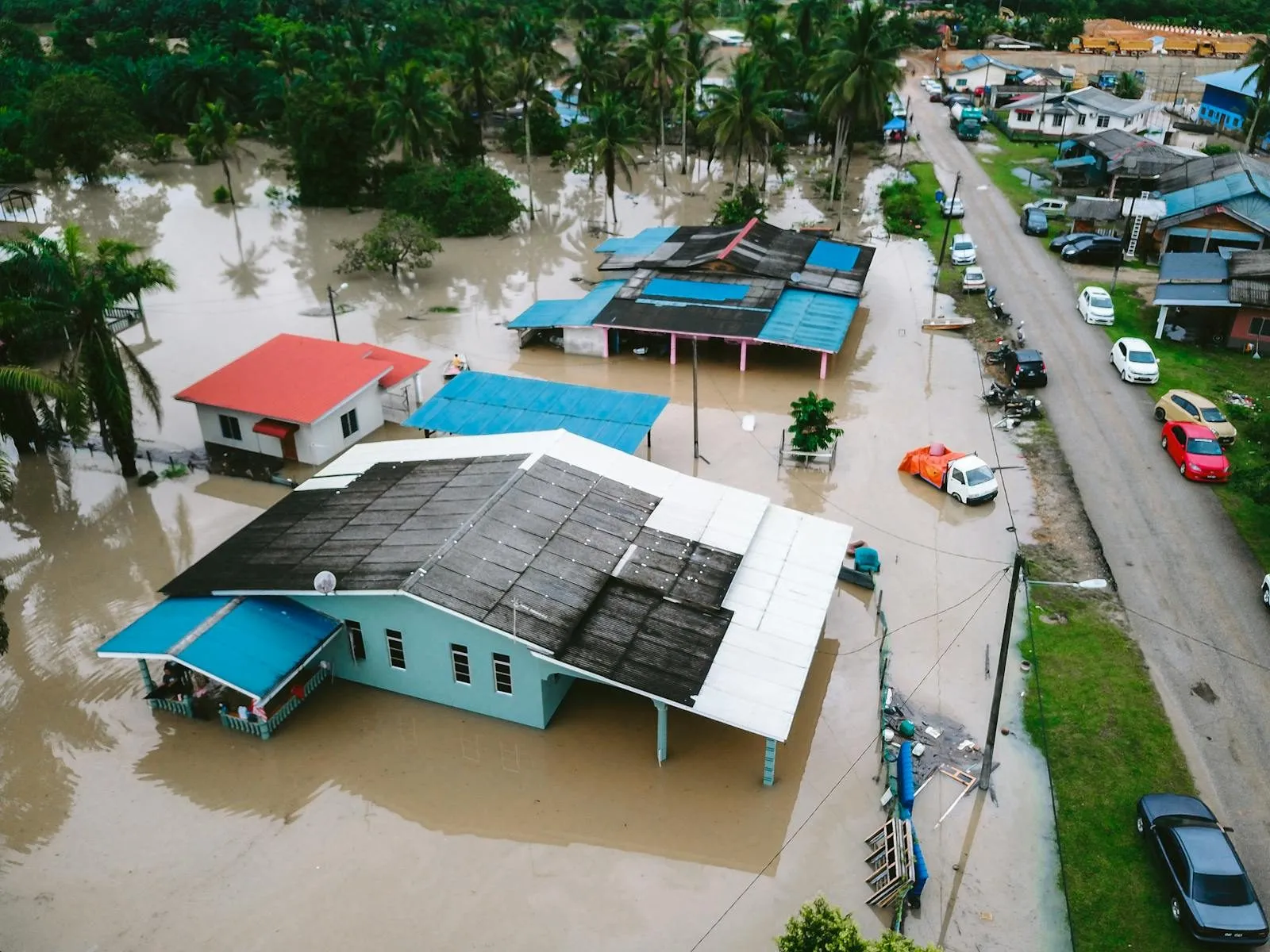
Swiss Re’s latest sigma report put global insured catastrophe losses for 2025 at US$107 billion, a figure that has already been revised once as more data came in and will likely be revised again. The composition of that number is the interesting part. Wildfires and storms, along with floods, accounted for a record-equalling 92 per cent of the total, with wildfire insured losses growing at around 12 per cent a year (the fastest rate for any single peril). Swiss Re’s central projection for 2026, assuming losses return to the trend line, is US$148 billion. In a peak-loss scenario the same projection reaches US$320 billion (Swiss Re Institute, 2026). These are the numbers that define the envelope within which the global insurance industry is now operating, and the envelope has moved substantially from where it was even five years ago.
For most readers the more telling illustration is California, because California has been a leading indicator for how insurance markets adapt to climate risk in a wealthy jurisdiction. Premiums in fire-prone postcodes have jumped roughly fourfold over the last few years, from an average of around US$4,500 per policy to approximately US$18,000, as insurers repriced coverage to reflect the underlying risk. Several major carriers have withdrawn from parts of the market entirely, and others have stopped writing new policies in designated high-risk zones. A state-level moratorium has temporarily slowed the withdrawal process, but most observers expect the moratorium to wind back over the next few years, and the expectation inside the industry is that the mass non-renewals that have been held in check will then happen quickly (California Department of Insurance, 2025). California is not a cautionary tale for Australia. California is a preview.
The point that deserves more weight in Australian discussion is that the insurance industry is doing exactly what it was designed to do, even though the effect on consumers looks unusual. Insurers price risk on expected losses. When those expected losses climb, premiums follow, and where the numbers no longer support writing new policies, coverage is withdrawn. The industry is making an actuarial judgment about cash flow rather than a political judgment about climate change. The actuarial judgment is running well ahead of the policy judgment in every country that has been affected, which by now includes most of the OECD.
The OMFIF analysis of the protection gap, published in February 2026, is useful because it reframes the problem from an insurance question to a financial stability one (OMFIF, 2026). The protection gap (the difference between economic losses from a disaster event and what insurance actually covers) is widening across both advanced and emerging economies, and the widening is accelerating. In emerging economies, roughly 80 to 90 per cent of catastrophe losses remain uninsured. In advanced economies, the gap is smaller in percentage terms but much larger in absolute dollars, and it is the absolute number that determines whether a national treasury can absorb a bad year without structural damage to fiscal position. Once the uninsured share of losses starts to grow faster than the insured share, the difference flows through to government balance sheets as disaster recovery payments and reconstruction grants, and ultimately as debt.
For Australia, the January 2026 Victorian bushfires are the most recent domestic case where the protection gap became visible in real time. The precise split between insured and uninsured losses is still being worked out across the claims cycle, but preliminary figures suggest a significant portion of the economic loss will not be recovered through standard household or commercial insurance policies. Property valuation frameworks are being updated in parallel to integrate bushfire and flood risk into mass appraisal and automated valuation models, which is a necessary but politically awkward step because it tends to depress property prices in affected areas and therefore to create unhappy electorates in exactly the places where the physical risk is concentrated.
This is where the policy question gets genuinely difficult. Who bears the residual risk when private insurers withdraw? There are three main options and each has significant problems. The first is that the household bears the risk, which translates into uninsured families losing their main asset in the event of a bad fire season and forcing an ad hoc recovery response from whichever government is closest. This is what happens by default when no other policy intervention is in place. The second is that the state takes on some form of guaranteed insurer role, either directly through a state-owned vehicle or indirectly through reinsurance subsidies. Both variants transfer climate risk from private balance sheets to public ones, which is appropriate in some senses but creates a moral hazard problem because it reduces the signal that premiums send about where people should and should not be living. The third option is land-use policy that actively discourages new construction in high-risk areas and incentivises relocation from existing high-risk dwellings, which is the most effective long-term strategy but politically the hardest to implement because it requires the state to tell specific identifiable constituents that they should move.
None of these options is comfortable. All of them are already under active discussion in various corners of the Commonwealth, and none of them has a clear champion in the current political configuration. The Australian Prudential Regulation Authority has been tracking climate risk in the insurance sector for several years and its work is cited regularly in financial stability reports, but the work is advisory and the authority to act on it sits with other agencies.
The cross-reference to the climate attribution article I wrote earlier is worth spelling out here. The Bergquist 68-country study that work rested on found that subjective attribution of extreme weather to climate change is what drives public support for climate policy. The insurance market is doing the attribution step automatically (its actuaries do not need to believe in climate change, just in their loss data) but the public that ultimately votes on the policy response does not process insurance repricing as a climate signal. A family in a high-risk bushfire postcode whose premium has just quadrupled typically experiences that as an insurance industry problem, not as a climate policy problem, and votes accordingly. The political feedback loop is not firing.
For consultants and strategic advisors working in or around this area, the widening gap between actuarial reality and political willingness to act on it is precisely where advisory value sits. Governments need help understanding how climate risk repricing affects infrastructure investment timelines and community resilience planning, alongside land-use policy at the wildland-urban interface and fiscal exposure in the medium term. State governments need help thinking through the implications of their existing residential land releases in areas moving toward partial uninsurability. Commonwealth agencies need help on the distributional consequences of any state-based insurer of last resort, because a national response will have to reconcile the different exposures across jurisdictions. Private sector clients in property and infrastructure, and in the broader real assets space, need help understanding what repricing does to their long-dated investment theses.
This is also an area where the resourcing argument from the fire weather attribution article comes back into play. The scientific case for treating the climate context as a permanently elevated baseline is settled. The actuarial case for repricing is settled. The insurance industry is acting on both. What is missing is the corresponding policy case, and the distance between actuarial reality and policy response is widening faster than the political system is prepared to close it. That distance is the protection gap in its fullest sense. The narrow meaning (the dollar difference between economic loss and insured loss in any given year) is the part that shows up in Swiss Re’s numbers. The wider meaning is the gap between what climate science and insurance markets (and, increasingly, land-use planners) can already see coming, and what the political system is prepared to act on.
References
- Australian Prudential Regulation Authority. (2026). Climate risk and insurance market coverage update. APRA.
- California Department of Insurance. (2025). Fire-prone area premium and coverage data. State of California.
- OMFIF. (2026, February). The insurance protection gap: a growing risk to financial stability. Official Monetary and Financial Institutions Forum. https://www.omfif.org/2026/02/the-insurance-protection-gap-a-growing-risk-to-financial-stability/
- Swiss Re Institute. (2026, March). Natural catastrophes in 2025: the persistent rise of wildfire and storm risk. sigma 1/2026. Swiss Re. https://www.swissre.com/institute/research/sigma-research/sigma-2026-01-natcat-2025-wildfire-storm-risk.html
- World Economic Forum. (2026). Climate loss and insurance coverage. WEF.