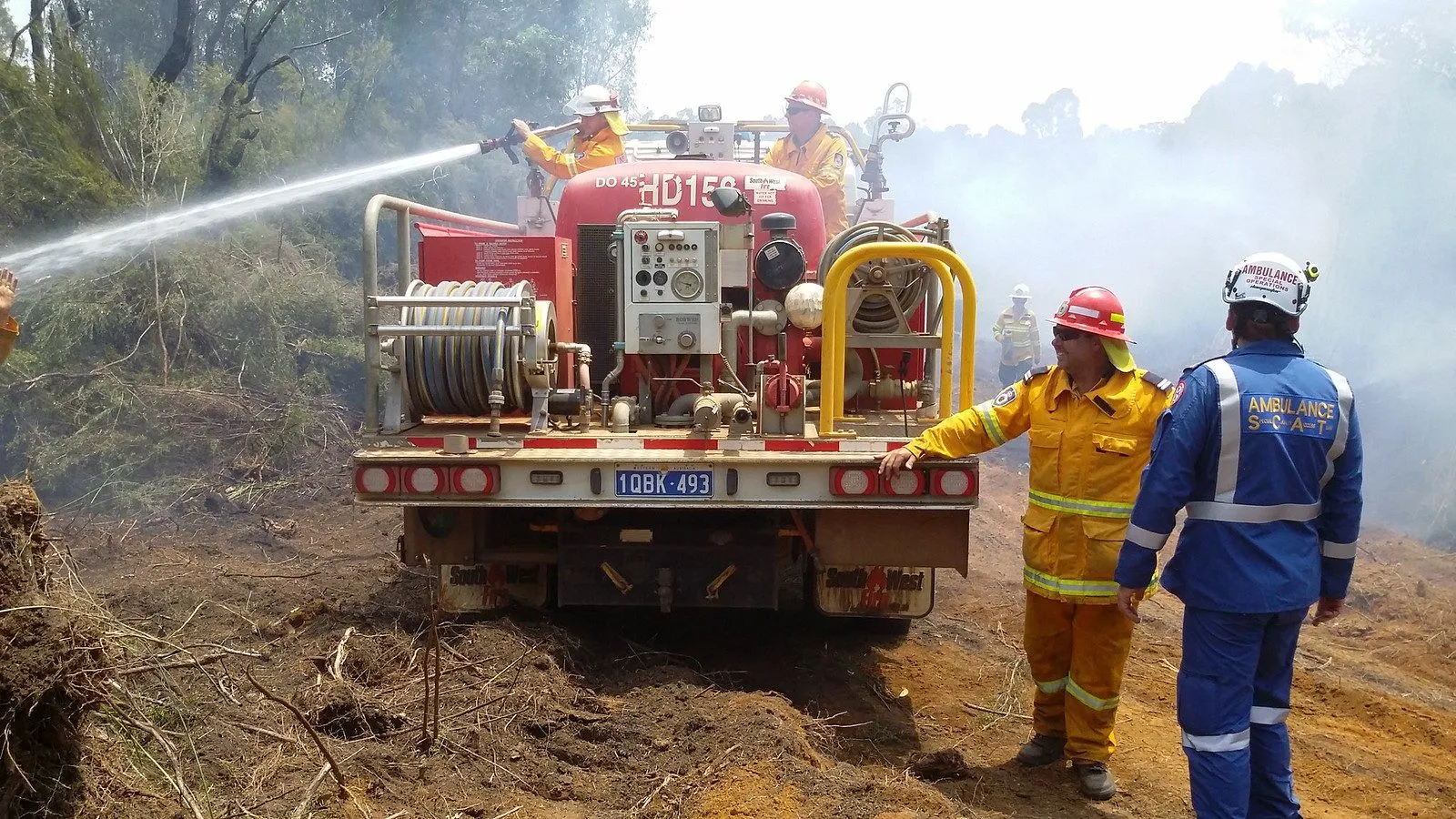
In a single week of 2026, wildfire research advanced on every front available to it. CSIRO and partners published a neuromorphic network capable of detecting thermal anomalies from raw Sentinel-2 satellite data within the satellite’s acquisition window, opening a path to onboard processing for near-real-time bushfire warning. A separate group released FireCast-Fusion, a deep-learning framework that takes UAV imagery and environmental data and produces probabilistic fire-front maps with pixel-level arrival times for incident commanders. A machine-learning probabilistic bias correction framework doubled subseasonal forecast skill for AI weather models, directly supporting the two-to-six-week planning horizon that fire agencies currently struggle to populate with credible data. The Country Fire Authority, in the same week, completed its first goat grazing fuel-reduction project at Gateway Island in Wodonga and reported “remarkable results” over five weeks of intervention.
The technology range, in other words, was substantial. The week’s most important wildfire research, however, was not about any of those tools. A literature review on wildfire decision support tools, published in Fire Ecology on 23 April, examined why agencies routinely fail to adopt the support tools that researchers and vendors keep building for them. The finding was concise. The barriers are communication failures and capacity gaps inside a wider cultural mismatch between the developers and the practitioners. Technical limits are not the binding constraint. Trust and user-friendly design, paired with practical training, are the enablers. The technology is sufficient. The surrounding system is what fails.
That diagnosis mirrors a thread I have written about separately in the context of AI governance more broadly. The deployment of advanced models in government settings is moving faster than the human and organisational architecture around them. In wildfire management, the version of that gap is more concrete because the cost of a tool that goes unused or gets misused is measurable in hectares and lives. The PALEI framework, tested this week in high-risk Los Angeles neighbourhoods and described in a 22 April arXiv paper, is the most worked-through response I have seen to the diagnosis. PALEI stands for Participatory AI Literacy and Explainability Integration. The framework runs community co-design and AI literacy work ahead of model deployment, rather than as a follow-on training round. The Los Angeles trial reported significantly improved public trust in wildfire risk tools and significantly higher adoption of the tools that resulted. The sequencing point is the one to pull out: literacy first, then model deployment.
For Australian fire agencies, the implication is uncomfortable in budget terms. The standard procurement pathway for a decision support tool runs through scoping, design, build and delivery, with training appended at the end. PALEI argues that the literacy and co-design phase belongs inside the design itself, ahead of the rollout. That requires a different kind of procurement template, with the funding profile shifted to the front of the project and the agency-community relationship rebuilt around that profile. None of those changes are impossible. They are also not where the dollar is currently going.
Two further results from the same week underline how technical the conversation tends to be while the practitioner gap remains untouched. A UK field study on fuel moisture content found that landscape variables (topographic factors such as elevation and aspect, alongside soil type and drainage) significantly influence fuel moisture in ways current weather-only models miss entirely. Australian fire danger rating systems are largely weather-driven. The implication is that without a landscape-correction layer, fire danger in some terrains is being systematically misestimated. The fix is straightforward in principle, but it requires a coordinated update across the rating system and the briefing tools, plus the training material that fireground commanders rely on. The work is coordination rather than science.
A separate paper found that prescribed burns in pine forests significantly increase the incidence of Diplodia shoot blight, with burned areas showing more than double the disease severity of unburned controls. That is the kind of secondary ecological finding that has historically struggled to make its way into prescribed burn planning, partly because it crosses the boundary between fire ecology and forest pathology, and partly because the fire planning tools that are in operational use rarely ingest disease-vector data. The DST review’s finding on cultural mismatches lands here too. The data exists and the science exists, but the operational planning tool does not have a slot for it, and so the practitioner cannot use it.
The Mediterranean fire season projections published this week add a strategic horizon to the same problem. Fire seasons in the Mediterranean basin are projected to lengthen by several weeks and to start over a month earlier by the end of the century. Australian fire managers tracking the international research because their own fire seasons are following similar trajectories will have a direct interest in those projections, particularly given the converging argument I have written about separately on the end of sequential mutual aid in global wildfire response. A planning horizon stretching two to six weeks ahead of a fire season that begins a month earlier than the current calendar assumes is exactly the planning task the new ML probabilistic bias correction work is designed to support. Whether Australian fire agencies are positioned to absorb the new forecast skill into their seasonal planning cycle is a procurement and training question rather than a science question.
The CFA goat grazing project deserves a separate note because it sits at the opposite end of the technology spectrum from the satellite work, and demonstrates the same lesson. Fuel reduction by ruminant grazing is not a new idea. It has been used in southern Europe for decades and in California for the better part of fifteen years. The CFA’s Gateway Island trial at Wodonga is the first formal Australian application I am aware of, and the early results are useful in their own right. The deeper lesson is that the practitioner-facing innovation that actually moved the needle this week was a low-tech fuel reduction trial rather than a frontier AI capability. For agencies whose fuel-reduction backlog is the limiting reagent on the next fire season, a goat trial that produced “remarkable results” in five weeks is a more usable contribution than another satellite product that requires a year of integration work to operationalise.
The cross-cutting reading from the week is that the wildfire research community is in danger of repeating the AI governance failure in microcosm. New tools are being built faster than the practitioner architecture around them is being updated. The DST review and the PALEI framework are both saying that the work agencies most need to fund is the participatory communication and training work rather than another procurement of another product. The technology is overwhelmingly headed in the right direction. The question is whether the human side of the system can keep up, and the answer this week is that it has not yet started to.
The temptation, for any agency reading this batch of research, is to bolt the new science onto the existing tool stack and call it modernisation. The DST review’s finding rules that out as a viable strategy. Adoption follows trust, which itself follows comprehension built through participatory design. A wildfire decision support stack that is operationally trusted in 2030 will be one that was co-designed with brigade captains and incident controllers, alongside planners and volunteers, from the start. That is the contribution agencies should be commissioning. The satellites and the goats can wait.
References
- Country Fire Authority. (2026, April). Goats used to successfully reduce fire risk in Wodonga. https://news.cfa.vic.gov.au/news/goats-used-to-successfully-reduce-fire-risk-in-wodonga
- Fire Ecology. (2026, April 23). Wildfire decision support tools – barriers, facilitators, and future directions [literature review].
- SRS / Springer. (2026, April 18). FireCast-Fusion – deep learning framework fusing UAV imagery with environmental data for fire spread prediction.
- arXiv preprint. (2026, April 22). PALEI – Participatory AI Literacy and Explainability Integration framework, Los Angeles trial.
- arXiv preprint. (2026, April). Machine-learning probabilistic bias correction for subseasonal AI weather forecasting.
- arXiv preprint. (2026, April). Neuromorphic detection of thermal anomalies from raw Sentinel-2 satellite data.
- Field study (UK). (2026). Influence of landscape variables on fuel moisture content – implications for fire danger rating.
- Aijourn / Fire Grand Challenge. (2026). Fire Grand Challenge winners – community AI wildfire tools. https://aijourn.com/fire-grand-challenge-recognizes-top-teams-building-the-next-wave-of-wildfire-tools/