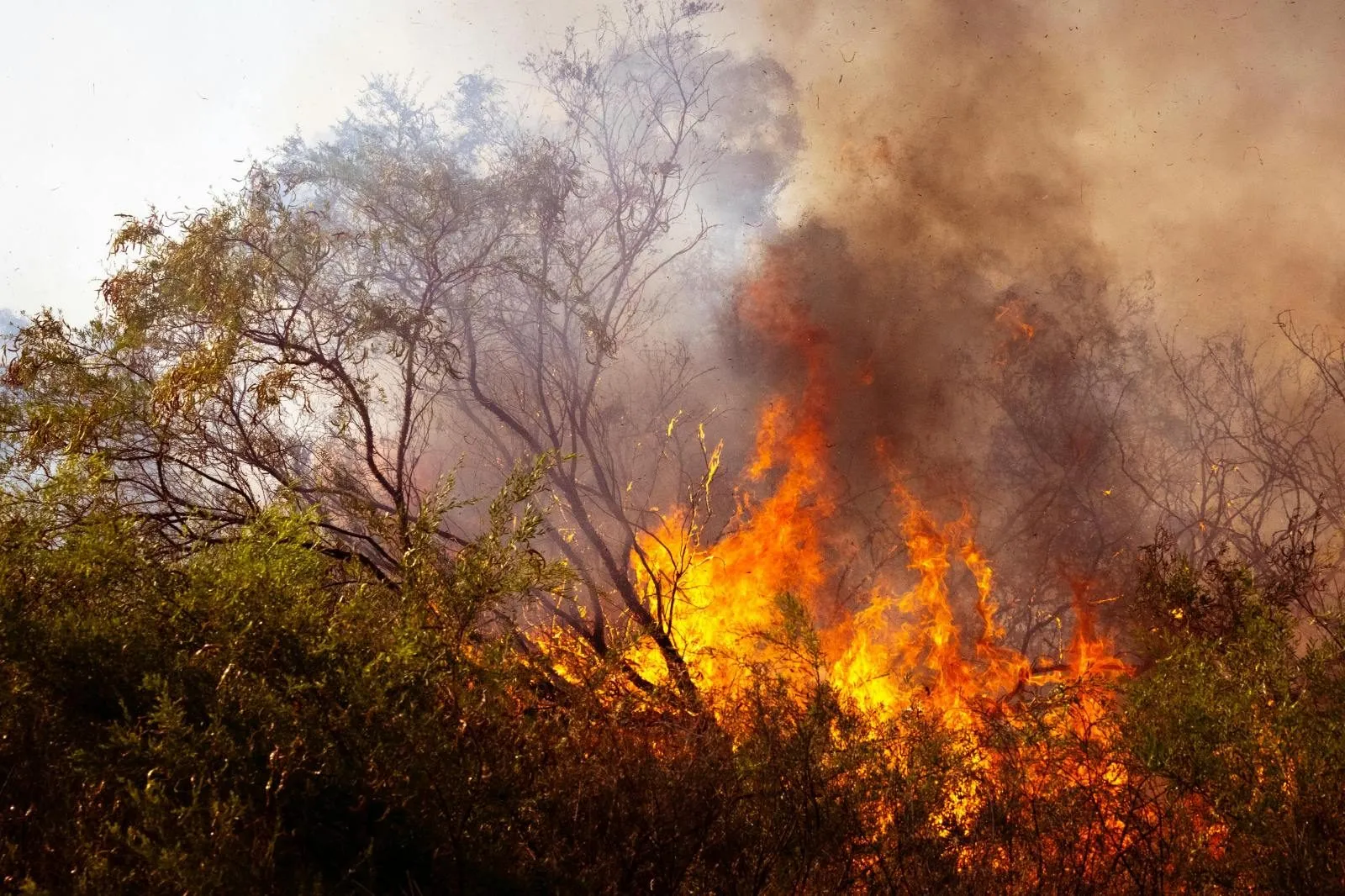
An anonymous Zenodo deposit on 18 May 2026 (titled Wildfire Size Disparity on Tribal Lands in California and Associated PM2.5 Burden, 2000-2018) reports that wildfires on federally recognised tribal lands in California were on average 15.7 times larger than fires on adjacent non-tribal lands across the 2000-2018 period. Mean fire size: 42,572 acres on tribal lands, 2,706 acres on non-tribal lands. The analysis uses five causal identification strategies and panel econometrics to support the disparity finding against confounders. The paper also quantifies the air-quality consequence: the 2003 Cedar Fire alone produced a maximum AQI of 328 (Hazardous) across multiple San Diego County tribal nations, a 125% spike over baseline.
The substantive attribution in the paper is fuel accumulation from a century of suppression of traditional Indigenous burning practices under federal fire management policy. This is the empirical claim the paper anchors. The mechanism is well-established in the fire ecology and Indigenous fire management literature. Fire-adapted landscapes that were burned at high frequency by Indigenous peoples for thousands of years accumulated fuel loads outside the historic range of variability when suppression was imposed. The fires that eventually do come through those landscapes are much larger and much more severe than the fires the landscapes were calibrated for. The 15.7x figure quantifies that mechanism at the scale of a federally recognised tribal land in California.
For Australian fire and land management agencies the parallels are immediate. The First Peoples managed this landscape with fire for tens of thousands of years. The cessation of cultural burning following colonisation has contributed to fuel accumulation across large parts of the continent, with biodiversity loss and increased wildfire severity following as second-order consequences. The argument has been made in Australian fire science for at least two decades. What the California study contributes is a hard quantitative comparison against an adjacent, otherwise-similar non-tribal land control. Australia has not produced an equivalent study at the same scale. The strongest local quantitative work remains the savanna fire methodology research from northern Australia, which documents emissions outcomes (and area outcomes alongside them) from Indigenous savanna burning programs but does not directly compare against a fuel-accumulated colonial-management counterfactual.
California has begun to respond to the evidence. On 7 March 2025 the Karuk Tribe and the California Natural Resources Agency signed a landmark cultural burning agreement, the first compact under California’s SB 310. The agreement formalises a state-tribal partnership on cultural burning that has been informally developing for years. CAL FIRE’s Tribal Wildfire Resilience grants program now supports tribes in managing ancestral lands using Traditional Environmental Knowledges. The 2024 Greenler et al. study, published in Ecological Applications by an Oregon State University-Karuk Tribe collaboration, estimated approximately 7,000 cultural ignitions per year across a 650,000-acre subset of Karuk Aboriginal Territory before colonisation, burning roughly 15 per cent of that landscape annually. The Greenler figure is the named-author quantitative anchor for the broader argument: Indigenous fire management ran the landscape at a frequency and intensity Western fire management does not currently match.
In Australia, cultural burning programs are expanding but constrained by regulatory complexity and insurance arrangements, on top of funding levels that do not match the pace at which fire risk is increasing. The Victorian Traditional Owner Cultural Fire Strategy, launched in May 2019 by the Federation of Victorian Traditional Owner Corporations together with state agencies (with a A$22.5 million Victorian Budget 2021/22 commitment), is the most institutionally developed Australian equivalent. The Northern Territory’s Indigenous savanna fire management program is the longer-running and more mature analogue, with 32 Indigenous-owned projects across 22 million hectares since the early 1980s and approximately A$95 million generated in ACCUs. Western Australia’s environmental management agency (the Department of Biodiversity, Conservation and Attractions) operates a cultural burning policy alongside joint-management arrangements with Traditional Owners. The three are not structural equivalents of each other and they certainly are not structural equivalents of the California SB 310 compact framework, but they constitute a real Australian cultural-burning ecosystem that the next round of national wildfire policy investment can build on.
The regulatory and funding barriers are familiar and consistent across the three Australian jurisdictions. Insurance arrangements treat cultural burning as a non-standard fire activity even when the practitioners are highly experienced. State environmental protection legislation is calibrated for emission limits set without reference to Indigenous fire management knowledge. Funding cycles for cultural burning programs run shorter than the planning horizons required to staff and resource the programs sustainably. The Greenler et al. cadence of approximately 7,000 ignitions per year across a 650,000-acre area was sustained for centuries. The contemporary Victorian and NT programs (with WA following them) are working at one or two orders of magnitude below that frequency, in landscapes where the fuel-accumulation problem is now structurally similar to the Californian one the 15.7x paper is documenting.
I have written separately about the wildfire decision support procurement gap, the visibility-efficiency paradox in resource allocation, and the wildfire-energy convergence Australia inherits from California. The Indigenous fire management argument runs in parallel to those three. They are all examples of the same broader claim: that Australia is approaching the operational edge of what suppression-based wildfire management can deliver under intensifying fire weather, and that the structural alternatives (cultural burning, decision support that practitioners actually adopt, resource allocation independent of social-media salience) are running well behind the rate at which the suppression model is hitting its limits.
A 15.7x disparity is the kind of number that reshapes a policy argument. The cultural case for restoring Indigenous fire management authority has always been clear. The operational evidence now matches it, with named-author research from Greenler and colleagues providing the per-frequency anchor and the anonymous-deposit California study providing the comparative scale. Regulatory and funding settings remain a generation behind both arguments. The case for catching them up is no longer one that has to be made primarily on cultural grounds. It is one that the operational and risk-management evidence now supports on its own terms.
References
- Anonymous. (2026, 18 May). Wildfire Size Disparity on Tribal Lands in California and Associated PM2.5 Burden, 2000-2018. Zenodo. https://doi.org/10.5281/zenodo.20270947
- California Wildfire and Forest Resilience Task Force. (2025, 7 March). California advances wildfire resilience and honors tribal sovereignty through cultural burning agreement with the Karuk Tribe.
- CAL FIRE. Tribal Wildfire Resilience grants program. https://www.fire.ca.gov/what-we-do/grants/tribal-wildfire-resilience
- Department of Biodiversity, Conservation and Attractions, Western Australia. Cultural burning policy and joint management arrangements.
- Federation of Victorian Traditional Owner Corporations. (2019, May). Victorian Traditional Owner Cultural Fire Strategy.
- Greenler, S., Lake, F. K. et al. (2024). Cultural ignition frequency in Karuk Aboriginal Territory. Ecological Applications.
- WWF Australia. New study confirms Indigenous fire management equals success.