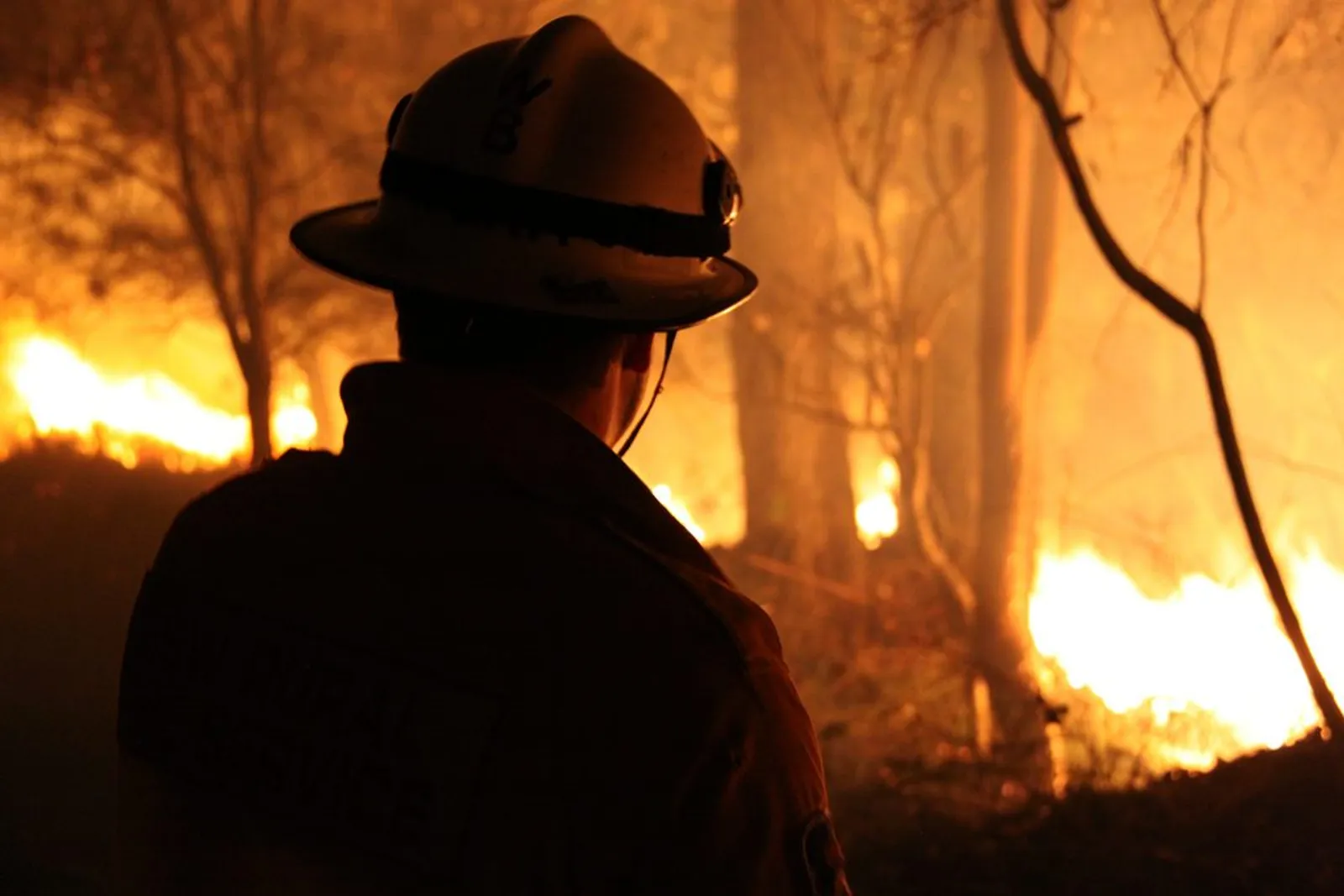
In late May a bushfire ran into a patch of Ross Creek State Forest near Staffordshire Reef Road in Victoria, and then it slowed. The forest there had been treated with a planned burn some time earlier, and when the fire reached that treated ground its behaviour changed enough that crews could hold it. The CFA documented the case through its own news channel. It is not a model output or a statistical projection. It is a real fire that hit a real burn line and lost momentum, which is the kind of evidence the prescribed-burning argument has always needed and rarely gets in a form this concrete.
The timing gives the case extra weight. In the same week, the CFA warned that Victoria should prepare for an earlier-than-usual bushfire season this spring, driven by below-average rainfall and a continuing drying trend. That warning arrived barely five months after the 2025-26 season ended, a season that burned more than 436,000 hectares and destroyed over 1,590 structures. An early start to the next season, so soon after a destructive one, is exactly the condition under which pre-emptive fuel treatment stops being a planning abstraction and becomes an operational priority.
There is a quieter point worth making about how the Staffordshire Reef case reached the public at all. Agencies publishing their own operational evidence, fire by fire, is a transparency practice that builds the case for prescribed burning more durably than any single study can. Individual cases like this one accumulate into an evidence base that is harder to argue with than a model, because each case is a fire that actually happened and a treatment that actually held. The CFA putting these accounts on the record is the sort of communication work that pays off slowly and is easy to undervalue until the season turns.
The case for burning before the fire also has a history that Australia has been slow to confront. A study published in late May traced an 1847 Western Australian ordinance that was framed as bushfire management but functioned to suppress Noongar cultural burning across Noongar Boodja. The suppression was not incidental. It removed a fire regime that had shaped the landscape for millennia, and the fuel accumulation and altered fire behaviour that followed are still legible in the country today. That history is directly relevant to the current debate about restoring Indigenous fire authority, a debate I have written about separately in looking at the measured disparity between cultural-burning landscapes and the wildfire outcomes that follow their removal.
The ecological evidence is widening the case beyond the protection of houses and assets. A study in the Northern Territory’s Garig Gunak Barlu National Park on the Cobourg Peninsula found that increasing late dry-season fire frequency inland from the coast was directly associated with declining and unstable mammal populations. Earlier-season and mosaic burning, by contrast, supported recovery. The finding gives land managers a specific prescription tied to a result they can measure, and it supports First Nations-led burning as a biodiversity intervention rather than only a hazard-reduction one. Fire regime, on this evidence, is a lever for mammal conservation as much as for asset protection.
None of this means prescribed burning runs itself, and the economics explain why. Research on land-use adaptation confirms that a landowner’s privately optimal burning decision frequently diverges from the socially optimal one, which is the textbook case for policy instruments that align private incentives with the broader goal of risk reduction. The operational science is encouraging on this front. A study of repeated prescribed burns in California’s dry coniferous national-park forests found that repeat treatment maintained reductions in surface fuel loads without significant loss of live-tree basal area, which makes repeat burning a viable long-term strategy rather than a one-off intervention. Burn frequency turns out to matter as much as the burn itself, a point reinforced by tallgrass-prairie modelling showing fuel loads recovering past three tonnes a hectare within ten growing-season months of a burn.
Put the threads together and the case for burning becomes multi-dimensional in a way that is hard to dismiss. Operational effectiveness shows up at Staffordshire Reef, historical justice in the Noongar research, and biodiversity benefit in the Garig Gunak Barlu mammal data, with the economics explaining why none of it happens automatically. The convergence is the point. When operational, ecological, historical and economic evidence all push in the same direction, the binding constraint is no longer whether prescribed and cultural burning work. The constraint is the governance and the incentive structures needed to do them at scale. That is the same coordination problem running through most of what I write about wildfire, from the practitioner last mile in decision support to the way attention and resources get allocated across a fire season.
That governance gap is where the early-season warning bites hardest. A treated burn line stopped a fire at Staffordshire Reef because someone planned and lit that burn in a prior window, under arrangements that allowed it. The evidence for doing more of that work is now operational rather than theoretical, drawn from a fire that happened rather than a curve that was fitted. What remains scarce is the authority to act on the evidence and the incentive to act before the season rather than during it. With Victoria already warning that the season is coming early, that window is days and weeks, not the comfortable months agencies are used to planning around.
References
- CFA News. (2026, May 26). Staffordshire Reef Road fire stifled by previous planned burn.
- CFA News. (2026, May 28). Victoria to prepare for an early bushfire season.
- Outlawing of cultural burning on Noongar Boodja, 1847 [Preprint]. (2026, May 25). OpenAlex.
- Mammal change in Garig Gunak Barlu National Park and the late dry-season fire regime [Preprint]. (2026, May 26). OpenAlex.
- Repeat prescribed burns in California national park forests [Preprint]. (2026, May 28). OpenAlex.
- Economics of climate change adaptation through land use [Preprint]. (2026, May 25). OpenAlex.
- Prescribed burning frequency in tallgrass prairie [Preprint]. (2026, May 27). OpenAlex.