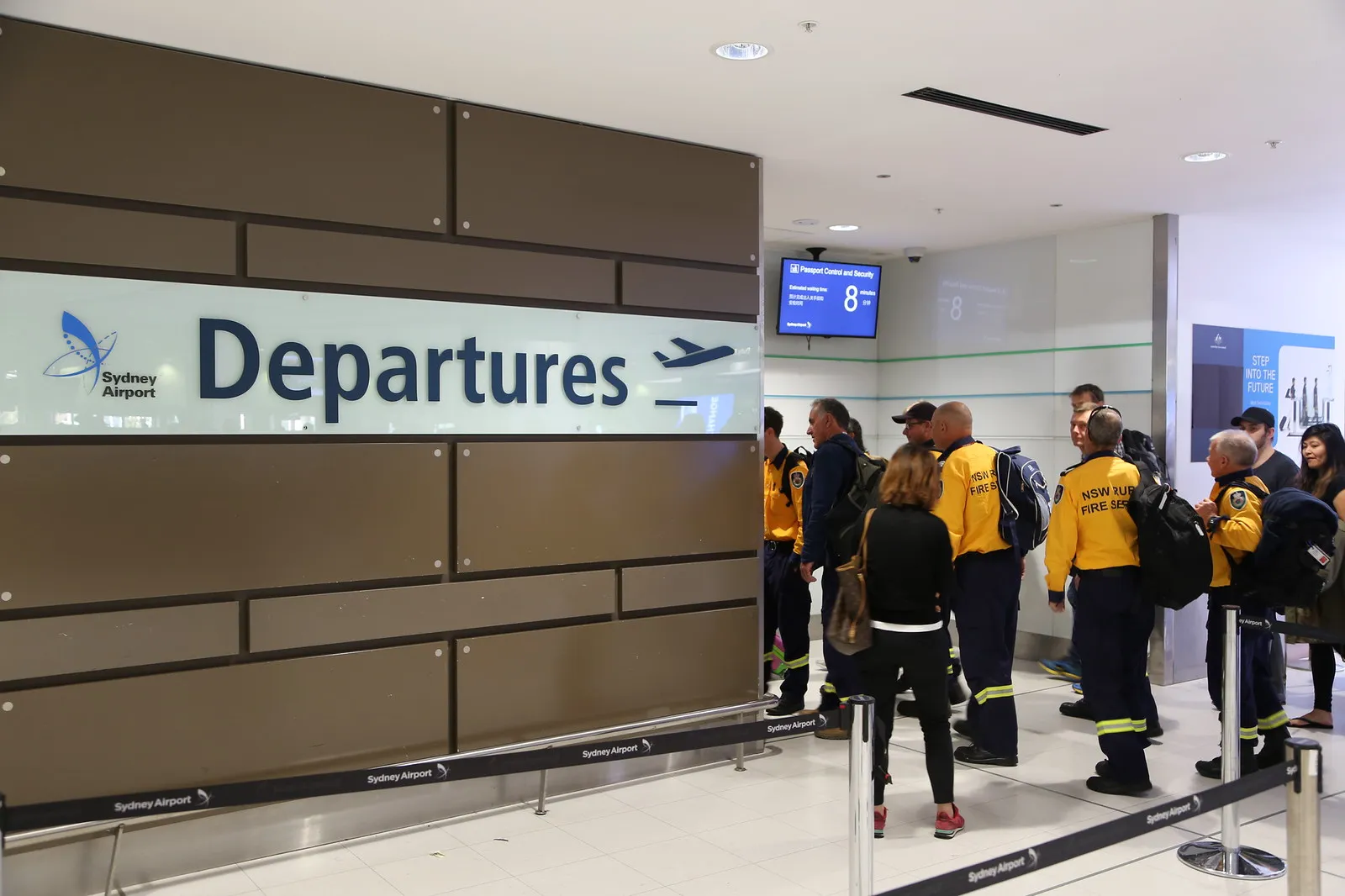
The worry most people carry about fire and climate change is that the seasons converge. That the Northern Hemisphere will burn while we burn, the aircraft will be committed elsewhere, and the arrangement Australia relies on will stop working. It is an intuitive fear, repeated in enough inquiries to feel settled.
The best global measurement of it says the opposite, and the opposite is worse.
Yin et al. (2026) examined synchronised extreme fire weather worldwide from 1979 to 2024 and found significant increases, more than a twofold rise in most regions. Over half of that increase is attributable to anthropogenic climate change. Extreme fire weather is now highly synchronised between four northern regions: North America, Europe, Boreal Asia, the Middle East. Africa and South America pair the same way. Australia is the exception. Fire weather here, the authors write, “rarely coincides with that of other regions”. They attribute that to geographic isolation and a distinct fire seasonality, most pronounced in the temperate south and southeast where the population and the suppression effort both sit.
So the counter-seasonality holds, and the pessimistic story that has shaped how people talk about deployment risk for years is wrong.
The authors draw the cheerful conclusion themselves: this separation, they write, “presents more opportunities for international cooperation in firefighting resource allocation with countries such as the US”. On its own, that is a good-news finding for Australia.
It is also only half the question.
Reciprocal deployment works if two things are true at once. The first is that our peak does not coincide with our partners’, so there is a time of year when they are free and we are not. That is the assumption the synchronicity paper tests, and it passes.
The second assumption is that when we call, the partner has something spare. Nothing in the counter-seasonality finding speaks to that, and it is where the same result cuts the other way. If the northern regions now burn in synchrony, the northern pool has less slack than it used to. Agencies that peaked at slightly different times could lend to each other and still have something left over for us. Agencies that peak together cannot. Our window is still open. What is on the other side is thinner.
Mutual aid is priced in planning documents as though it were insurance. It is not. Insurance pays out when your neighbour’s house is also alight, because the pool is capitalised in advance and the claims are independent. Mutual aid is a claim on someone else’s spare capacity at the moment you need it, and those claims are anything but independent.
The same problem exists inside Australia. AFAC’s Seasonal Bushfire Outlook for Spring 2026, released on 19 August, identifies an increased risk of fire in seven states and territories at once (Australasian Fire and Emergency Service Authorities Council, 2026b). It names northern and southeastern New South Wales, south-east Queensland, northeastern Tasmania, much of the Northern Territory, and areas within Western Australia, South Australia and Victoria. AFAC never adds them up, so the tally is mine, but the map is the map.
The climate driver behind that outlook is not ambiguous either. The Bureau of Meteorology’s monitoring of 29 September 2026 puts El Niño at “near-record levels”, with oceanic and atmospheric indices consistent with a strong event and further intensification forecast through the rest of spring. For the week ending 27 September the relative Niño3.4 index sat at +2.72 degrees, against a threshold of +0.80 (Bureau of Meteorology, 2026).
Interstate sharing fills the gap when a jurisdiction is overmatched, and it is substantial. In January, AFAC counted 342 interstate support personnel active in Victoria at one time, drawn from six other jurisdictions. Over a six-day period 500 resources were deployed there, along with 47 tankers from New South Wales and South Australia (Australasian Fire and Emergency Service Authorities Council, 2026a).
The National Resource Sharing Centre that coordinates this is a genuine asset, and it works by moving capacity that already exists. When seven jurisdictions are flagged together, less of that capacity is uncommitted. The Royal Commission into National Natural Disaster Arrangements said as much six years ago: “Lengthening and overlapping natural disaster seasons are testing these arrangements, limiting the ability of emergency services to help each other while maintaining local capacity.”
That finding is usually read as a warning about the future. The outlook for this spring reads like the condition it describes.
None of this argues against mutual aid. The arrangements are sound and the coordination has improved a great deal since 2020. The counter-seasonal advantage is real and rare.
What it changes is how a planner should treat borrowed capability in a business case. Planners have a habit, in resourcing submissions, of counting the National Resource Sharing Centre and the international arrangements as capability already held, because they have always delivered. They have. But capability that arrives only if nobody else needs it is not the same kind of asset as capability you own outright, and the two have been sitting in the same column for years.
The test worth applying to that column is unglamorous. Take each capability that depends on being borrowed and ask what happens in the season where it is not available. Then ask whether anyone has ever written that season down. Surge staffing and aviation contracts both deserve the question, and so do the interstate agreements. Most will survive it. The ones that do not are where the argument for owning the capability has to be made, and made early.
Made early is the hard part. A business case for capacity that is only needed when everything happens at once is the hardest case there is to fund, because the benefit is invisible in every year the borrowing works. It usually gets written after the season that proves the point, by which stage it is an inquiry recommendation rather than a budget submission. The gap between those two documents is about three years.
I have written before about a related failure, in The Tankers Arrived Before the Plan Did: when resources do move, the thing that breaks is the absence of any procedure saying who owns the decision. That is a problem about deploying what exists. This one comes before it, and asks whether there is anything to deploy.
The counter-seasonal advantage will still be there next year, and the year after. What has changed is that it has been holding up a second assumption it was never evidence for, and that second assumption is the one now worth testing.
References
- Australasian Fire and Emergency Service Authorities Council. (2026a, January 20). National resource coordination supports Australia’s summer bushfire response. AFAC. https://www.afac.com.au/public-resources/national-resource-coordination-supports-australias-summer-bushfire-response
- Australasian Fire and Emergency Service Authorities Council. (2026b, August 19). Seasonal Bushfire Outlook: Spring 2026. AFAC. https://www.afac.com.au/public-resources/seasonal-bushfire-outlook-spring-2026
- Bureau of Meteorology. (2026, September 29). Climate driver update: El Niño–Southern Oscillation. Australian Government. https://www.bom.gov.au/climate/enso/
- Royal Commission into National Natural Disaster Arrangements. (2020). Report, Chapter 6: National emergency response capability. Commonwealth of Australia. https://naturaldisaster.royalcommission.gov.au/publications/html-report/chapter-06
- Yin, C., Abatzoglou, J. T., Jones, M. W., Cullen, A. C., Sadegh, M., Wang, J., & Liu, Y. (2026). Increasing synchronicity of global extreme fire weather. Science Advances, 12(8). https://doi.org/10.1126/sciadv.adx8813