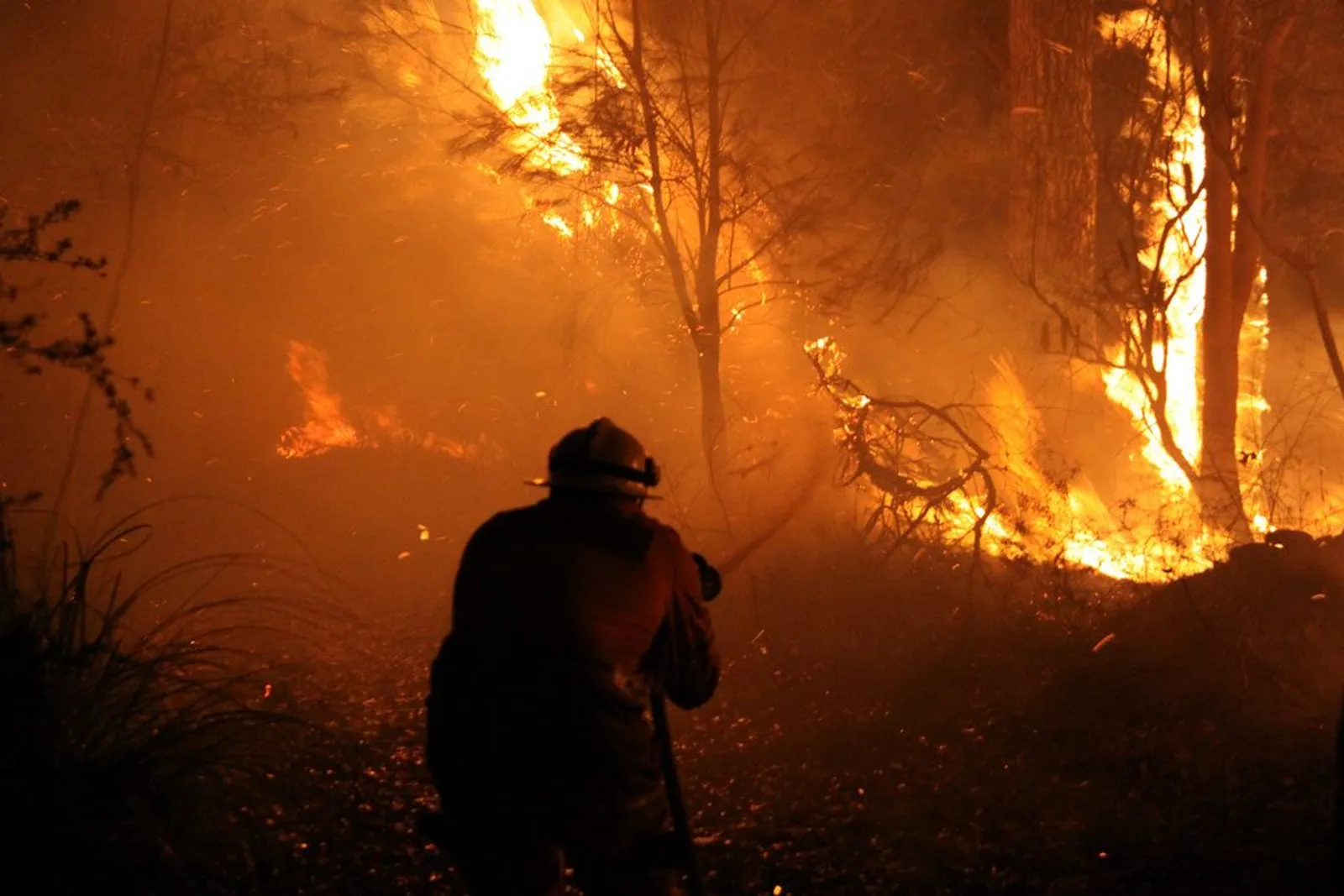
The Australian conversation about bushfire smoke is a respiratory one. It runs on asthma presentations and P2 masks and the air quality index, and the public health advice it has produced is genuinely useful. It is also incomplete in a way that now matters for how fire seasons get planned.
A study published on 28 July in the European Journal of Preventive Cardiology examined long-term exposure to bushfire-related fine particulate matter. It found a significant association with increased coronary plaque volume in asymptomatic adults already at risk of heart disease (Long-term exposure to bushfire-related fine particulate matter, 2026). Asymptomatic is the word carrying the weight there. These are people with no diagnosis and no reason to connect a fire season with their arteries. The plaque accumulates anyway, on a timescale that no air quality alert was ever built to communicate.
Two days later, Heart, Lung and Circulation published a retrospective audit of ST-elevation myocardial infarction incidence during major bushfire events in a regional health district (The Heart of the Inferno, 2026). The existence of that audit is a signal by itself. A regional health service went back through its heart attack presentations and lined them up against fire dates, because somebody there suspected a relationship worth testing. Clinical suspicion tends to run several years ahead of policy.
The respiratory framing held for so long because of how health effects get measured. An asthma presentation during a smoke event is same-day and attributable. Somebody arrives at an emergency department, the air quality index is high, and the connection makes itself. Arterial plaque does none of that. It accumulates over years, it presents as an event carrying a dozen plausible causes, and by the time it arrives the fire is a memory. Health systems count what announces itself, and smoke has been counted in the units that announce themselves fastest.
Nothing in that literature argues against hazard reduction burning, and the case for burning strengthened in the same week. A conceptual review in Frontiers in Forests and Global Change argues that fire, read through non-equilibrium ecological theory, works as a creative driver that restores biodiversity and prevents catastrophic wildfire when managed through prescribed and cultural burning (Creative destruction, 2026). The operational case is just as well established. Australia burns because the alternative is worse, and the alternative really is worse.
What shifts is the accounting. A paper released on 31 July set the health impacts of wildfire smoke in California against those of agricultural burning and prescribed fire. Wildfire smoke drives most smoke-related asthma emergency presentations, as expected. Agricultural burning and prescribed fire together account for roughly 35 per cent of smoke-attributable cases (Competing Health Impacts of Smoke, 2026). A third of a measurable health burden is being produced deliberately, by agencies acting correctly under policy, on days chosen by people with names and rosters.
The reflex is to read a number like that as ammunition for the anti-burning position. Underneath it sits the more useful finding. The burden is concentrated: a small proportion of high-impact burn days generates a disproportionate share of the cases. Most burn days are cheap in health terms. A few are expensive, and they are expensive because of where the plume travels and who happens to be beneath it when it arrives.
That distribution will look familiar to anyone who followed the heatwave research behind Half the Forest That Burns, on a Handful of Days, where a minority of days carried the majority of burned area. Burdens shaped like that reward scheduling over restraint. The policy question stops being how much to burn and becomes which days to burn on, which is a far easier question for an agency to act on.
Burn windows in Australia are currently set by two considerations: whether the fire will behave, and whether it will escape. Both are about the fire. A third consideration belongs alongside them and it concerns the smoke, specifically where the plume goes once the burn has been judged a success and which population sits downwind of it. Models exist for fire behaviour and for smoke dispersion, and they are rarely consulted by the same person on the same morning.
Who sits under those expensive plumes is not random, because protection from a plume is a purchase. Purchases of that kind are unevenly available: filtration units and sealed housing cost money, and the option of working indoors depends on what the job happens to be. The populations most exposed to a badly timed plume skew regional and older, and they carry more of the cardiovascular risk profile that the plaque study was measuring. Those populations are the ones a dispersion map would locate, so a burn scheduled without one is a distributional decision taken without anybody recognising it as such.
This is the point where the argument becomes a public administration problem as much as a fire one. If bushfire smoke drives cardiac presentations, then fire season is a health system capacity question. Emergency services plan for fire season, health services plan for winter demand, and the two cycles run under the same governments while barely speaking to each other. A cardiology unit in a regional district holds no seat at a burn planning table, and on this evidence it has a legitimate interest in one.
Public understanding gives that gap room to persist. A Scientific Reports survey from the same week found nearly three-quarters of Australians acknowledge the impacts of climate change, while fewer than 40 per cent recognise the consequences for health system resilience and workforce capacity (Australians recognise the effects of climate change, 2026). The consequences people recognise are the visible ones. The fire is visible and the fire truck is visible. The ambulance ramping three weeks later gets attributed to something else entirely, and costs that nobody attributes are costs that nobody budgets for.
The timing here is not abstract. Drawing on California’s fire climate, The Conversation warned on 26 July that Australia may enter spring with a highly flammable landscape and no room for complacency (The Conversation, 2026). Hazard reduction season is opening on that landscape, and the burn plans that will govern this spring are being written now, by agencies already carrying more constraints than they can comfortably satisfy. That is why the health evidence belongs in the system as a scheduling input rather than as another approval gate.
Three changes follow from taking the evidence seriously, and none of them requires burning less. Score candidate burn days for downwind population exposure alongside the meteorological check, so the costly ones are identifiable before they are booked. Give downwind health districts standing in burn planning instead of notification afterwards. Carry fire season into health service capacity planning the way winter demand already is.
The smoke was always going somewhere. What has changed is that we now know something about what it does when it gets there, and roughly which days do most of the damage. Spring is close enough that this season’s burn plans are still the ones that can use it.
References
- Australians recognise the effects of climate change but not its consequences for health system resilience and workforce capacity. (2026). Scientific Reports. https://doi.org/10.1038/s41598-026-64124-4
- Competing Health Impacts of Smoke from Wildfires, Agricultural Burning, and Prescribed Fires in California. (2026). https://doi.org/10.31223/x5cn4w
- Creative destruction: from fire ecology to management principles, a conceptual review. (2026). Frontiers in Forests and Global Change. https://doi.org/10.3389/ffgc.2026.1882526
- Long-term exposure to bushfire-related fine particulate matter and coronary plaque burden in asymptomatic adults. (2026). European Journal of Preventive Cardiology. https://doi.org/10.1093/eurjpc/zwag399
- The Conversation. (2026, July 26). The dangerous climate driving California’s wildfires and a warning for Australia.https://theconversation.com/the-dangerous-climate-driving-californias-wildfires-and-a-warning-for-australia-288190
- The Heart of the Inferno: A Retrospective Audit of ST-Elevation Myocardial Infarction (STEMI) Incidence During Major Bushfire Events in a Regional Health District. (2026). Heart, Lung and Circulation. https://doi.org/10.1016/j.hlc.2026.07.695