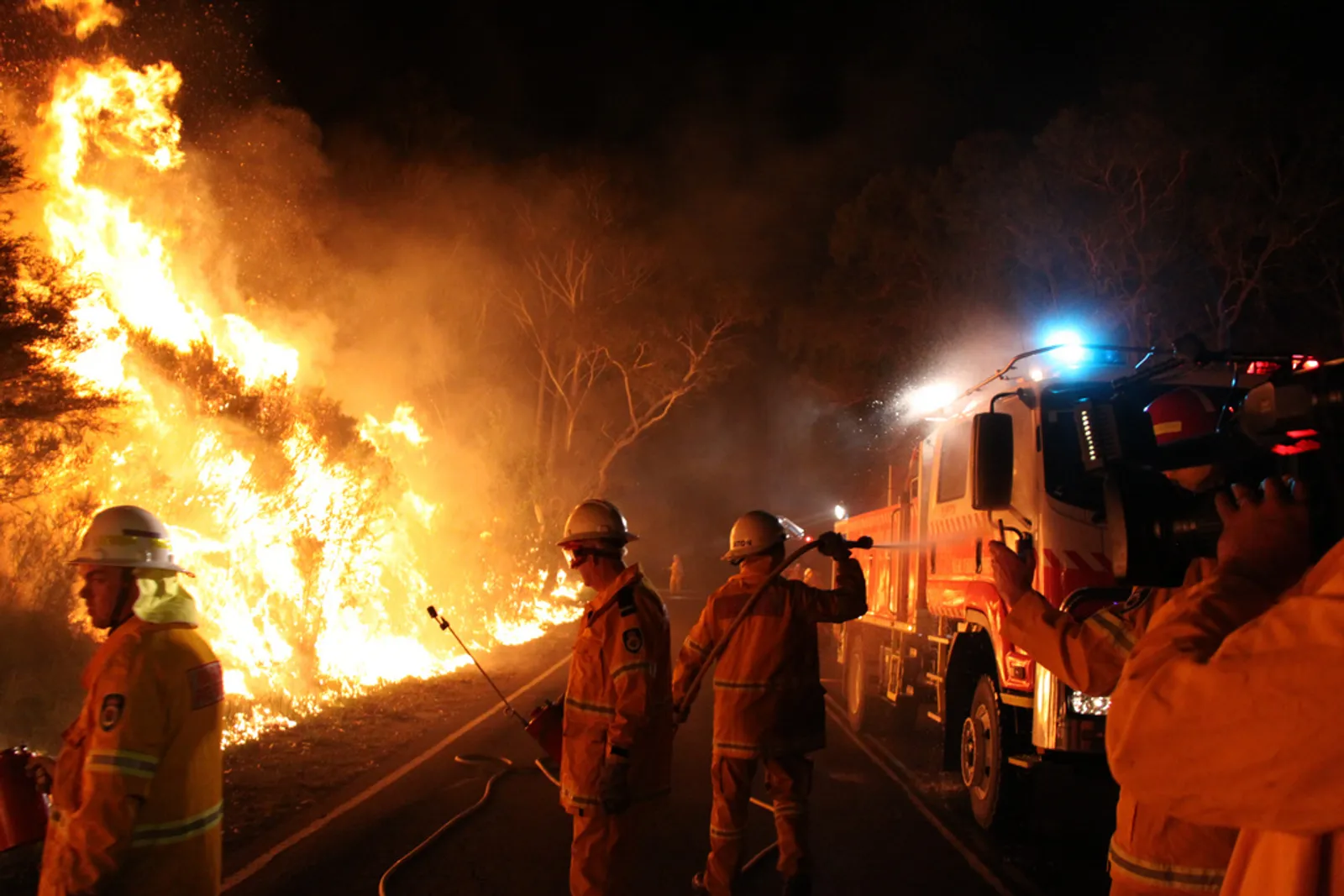
ForestrySA switched on a camera at the Mount Crawford Fire Tower in the Adelaide Hills on 10 September, describing it as the first AI-powered fire detection camera operating in a peri-urban area in Australia. Its job, in the agency’s own words, is to “continuously monitor the landscape for signs of smoke and potential fire activity” (ForestrySA, 2026). That is a single question asked over and over in one place. Three days before that launch, a research group posted a benchmark that put a much broader question to general-purpose multimodal models: what is happening in this picture?
The benchmark is called SAFIRE, and it has been reviewed, having been accepted into the Findings volume at EMNLP 2026 (Li et al., 2026). It is also large. The authors assembled 83,000 captioned images across 20 fire and smoke scenarios, then built 193,000 multiple-choice questions from a 9,700-image subset. They then scored ten open-source multimodal model configurations of between 8 and 38 billion parameters across ten dimensions of understanding, running from basic perception up to higher-order reasoning. Averaged over those ten dimensions, the models scored 61.9 per cent.
That single figure is the one that has travelled, and alone it invites the wrong reaction in either direction. Read generously, 61.9 per cent on a specialist test nobody trained for is respectable work from a model built to describe ordinary photographs. Read harshly, it sounds like a system that gets a third of the fireground wrong. Neither reading helps anyone evaluating a product, because the average describes how the test was assembled more than what the system can do.
The table behind the average holds the useful information. Across the ten models, identifying whether a human is present in the frame scored 90.3 per cent. Classifying the scene scored 76.4 per cent. From there the figures slide. Position identification, meaning where something sits in the frame, scored 57.6 per cent. General reasoning scored 53.3 per cent. The relationship in space between the fire and its smoke, which the authors call spatial correlation, scored 42.9 per cent (Li et al., 2026).
Hold that spread against what a common operating picture is made of. The questions that decide a shift are relational: whether the head of the fire is this side of the ridge or the other, and whether the crew is between the flame and the containment line or behind it. Where the smoke column is drifting matters only against the one road out. Each of those is a judgement about position and relation, which is the part of this test the models handle worst. The dimension they have close to solved, whether a person appears in the frame, a camera operator answers unaided in a second.
Two things make that spread more serious than it looks. The first is the format. These were multiple-choice questions, so the models chose among options with a correct answer somewhere in the set, which is gentler than describing an unfamiliar scene unprompted. The second is what a general model gives you when it is wrong. A detector flags smoke at a location, and a human can go and check it. A describer writes that the fire front is moving away from the structures on the left, in the same confident register as every other line in the log. Nothing in the output signals which part came from the pixels and which from the model’s sense of how fire scenes usually go. A confident description of a misread scene is harder to catch than a false alarm, because nothing about it asks to be checked.
Seen that way, the narrow scoping of the Australian deployments looks like a design choice rather than a limitation. Victoria’s Remote Sensing Bushfire Detection trial, funded by the Commonwealth and Victorian governments through the Disaster Ready Fund, put cameras on fire lookouts that are “configured to only detect smoke”, and set out to “assess the reliability and timeliness of smoke-detecting AI software” (Department of Home Affairs, 2024). That system supports the work of trained Fire Lookout Observers, and is most useful when a tower is unstaffed overnight or when conditions make staffing it unsafe. That is one task with one stated measure, and a person still in the loop. A system asked for multimodal situational awareness instead of smoke detection inverts every part of that. It takes on many tasks at once under a single aggregate score, and its output reads like analysis.
The second finding in the paper ought to change a procurement conversation. Adapting vision encoders with 7 per cent of the benchmark’s domain-specific data lifted accuracy on classifying its 20 fire and smoke scenarios from 20.1 to 64.5 per cent. The adaptation the authors tried was deliberately plain, and they say so in their own limitations: a linear probe over frozen image embeddings of that same data, together with a single supervised fine-tuning configuration (Li et al., 2026). Nothing there is expensive or novel. Curating the right fire imagery is what moved the number.
Those two results measure different things, and a vendor comparison that sets 64.5 beside 61.9 is holding a 20-way image classification up against an average of ten multiple-choice reasoning scores. The practical point is narrower. If a modest quantity of well-chosen imagery moves a plain classifier that far, a tender should carry the cheap option as a control condition. What does the simplest domain-specific model do on your own camera feeds, and what does the general multimodal system add on top of that? Without that comparison, nobody in the room can say what the premium is buying. A separate preprint on compressing fire-tuned vision-language models for embedded sensors offers a related point: compression changes a model’s failure modes as well as its accuracy (Kazzazi et al., 2026). Which errors a system makes belongs in the specification, next to how many of them there are.
One question underneath this has no answer yet. The benchmark’s imagery comes from two published research datasets and fifteen public Roboflow collections, together with stock libraries and video platforms including YouTube and TikTok. The set also draws on a program of controlled combustion experiments run at Khalifa University in Abu Dhabi between November 2023 and March 2024 (Li et al., 2026). That is a defensible way to assemble a benchmark of this size, and the set is organised by scenario type. Whether those scenarios represent Australian fuels and smoke is a separate question, and an open one. A eucalypt crown fire throwing embers kilometres ahead of itself, under a column that flattens against an inversion, is a different scene from a grass fire or a structure fire filmed on a phone. Before an agency treats these scores as a forecast about its own ground, someone should run the same ten models on Australian imagery and publish the dimension table.
This is a different fault from the one I worked through in Fewer Than One in a Hundred, where fire-prediction models are mostly validated on country they have already seen, which inflates their accuracy figures. Here the test design holds up and the sampling is honest. The weakness is the reporting convention: one average across ten dimensions of wildly unequal operational value, which is the one most likely to be quoted in a capability statement.
AFAC’s seasonal outlook, published on 19 August, puts parts of eastern Australia in its increased risk of fire category for this spring, so these buying decisions are being made now. A procurement that asks a vendor for an accuracy figure will be given one. Asking for the same result broken down by task is free, and testing the system on the agency’s own imagery is cheap. Those two results tell you which half of the job the thing can do.
References
- Department of Home Affairs. (2024, October 28). Testing AI’s potential for early bushfire detection [Joint media release with S. Dimopoulos]. Australian Government. https://minister.homeaffairs.gov.au/JennyMcAllister/Pages/testing-ai-potential-early-bushfire-detection.aspx
- ForestrySA. (2026, September 10). AI-powered fire detection camera launched at Mount Crawford. https://www.forestrysa.com.au/2026/09/10/ai-powered-fire-detection-camera-launched-at-mount-crawford/
- Kazzazi, M., Liu, Z., & Khajavi, S. (2026). Distilling vision-language models for on-device fire understanding. arXiv. https://arxiv.org/abs/2609.05782
- Li, P., Suryanto, N., Zhang, S., Alsharid, M., & Naseer, M. (2026). SAFIRE: Safety-critical benchmark for fine-grained fire and smoke understanding in multimodal LLMs. Findings of EMNLP 2026. arXiv. https://arxiv.org/abs/2609.07823