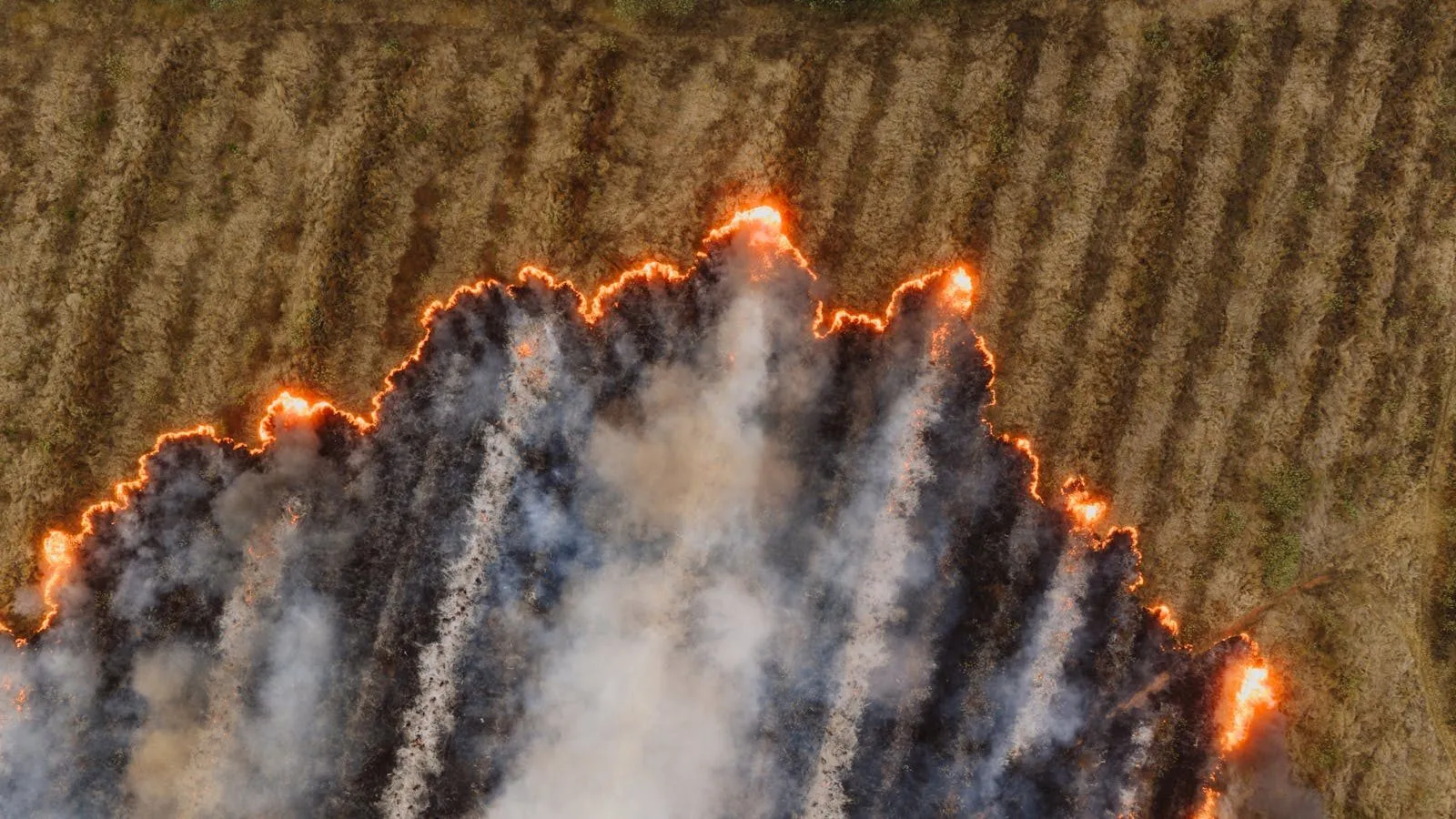
California enters the 2026 fire season with roughly 17,000 megawatts of battery storage on the grid. Public Safety Power Shutoffs remain scheduled as a deliberate part of fire-weather operations (California ISO, 2026). The state has more energy storage than at any point in its history. It still treats planned de-energisation as the safer option when winds turn. Pacific Gas and Electric has run staged PSPS programs since 2018; Southern California Edison and San Diego Gas and Electric followed in the same window. The triggers are Red Flag warnings and sustained wind thresholds across high fire-threat districts. A record battery fleet shifts the duration of a shutoff and the depth of customer impact. It does not remove the underlying logic, which is that energised distribution lines in extreme fire weather present an ignition risk the utility cannot insure against.
Three research threads converged on this problem in May 2026. Tapia and colleagues (2026) published a robust optimisation model that jointly sites battery storage and underground transmission to minimise the combined risks of wildfire-driven de-energisation and renewable variability. The case study uses a San Diego subnetwork, with stochastic fire-weather scenarios constraining the placement of new assets. Pearl, Warner and Lee (2026) demonstrated the WildFIRE-DS framework. It uses maneuverable Earth observation satellites with convolutional neural networks for image classification. A Bayesian updating layer then tightens the loop between overpass and alert. Reported detection latencies sit well under what a ground-only mutual-aid system can match. A third strand, separate work in remote sensing and forest inventory, has begun to find that the share of biomass loss attributable to wildfire in the western United States has risen materially since 2015, with the wildfire-driven loss component now absorbing most of the annual net change in forestland live biomass on the public-land side of the ledger.
Australia faces the same convergence on a different map. Renewable penetration has grown faster than transmission build. Bushfire-prone landscape sits underneath several of the corridors AEMO has committed to in the 2026 Integrated System Plan. The EnergyConnect interconnector between South Australia and New South Wales is one. The VNI-West proposal between Victoria and New South Wales is another. The transmission lines associated with Snowy 2.0 thread the southern alpine landscape. The Australian Energy Market Commission’s grid resilience reform agenda treats these corridors as critical infrastructure (AEMC, 2024). Critical infrastructure built into a landscape that burns more frequently and at higher intensity sits at the intersection of three policy worlds that do not share data well. Energy market design is the first. Emergency management is the second. Land use planning is the third.
The institutional shape of that intersection is the problem. No single agency owns wildfire-and-energy convergence risk. AEMO operates the market. AEMC sets the rules. State energy ministers coordinate through the Energy and Climate Change Ministerial Council. The National Emergency Management Agency holds national disaster coordination, while state fire services own ground response. Each has a defensible scope. None has a mandate to commission risk-weighted infrastructure investment decisions that balance wildfire ignition probability against renewable variability and demand peaks across a 20-year planning horizon. The optimisation tools exist (Tapia et al., 2026). The governance structures that would commission them, defend the outputs in front of inquiries, and update the models as fire seasons shift, have not been built.
The biomass finding compounds the gap. If official carbon accounts do not capture wildfire-driven live biomass loss at the scale recent remote-sensing work suggests, then Treasury climate liability modelling is reading the same landscape from incompatible data as Disaster Ready Fund prioritisation. The carbon side of energy policy is reading it differently again. The Productivity Commission’s 2023 review of natural disaster funding arrangements flagged this kind of data fragmentation as a structural weakness (Productivity Commission, 2023). The new evidence sharpens the cost of leaving it unresolved. For an infrastructure planner, the practical implication is that the climate baseline assumed in a 20-year transmission business case is increasingly inconsistent with the actual fuel-load trajectory on the ground, with second-order effects on fire intensity and frequency that recursively change the optimisation problem. A US$1.5 billion line approved against a baseline that understates fuel loss creates an asset whose insurable life is shorter than its depreciation schedule.
Reframe the problem in Article 27 terms (Buzby, 2026c) and the salience pattern shows up here too. PSPS events are visible. They generate customer complaints, political heat, and inquiry pages. Underinvestment in upstream optimisation is invisible until the fire weather arrives, by which point the placement decision is locked in for 20 years. The salience asymmetry pushes capital toward visible response (more batteries, more crews) and away from less-visible structural work (transmission undergrounding, risk-weighted siting). The robust optimisation literature exists precisely to make the invisible decisions defensible. It cannot do that without a body that will defend them.
Detection is now the cheap part. WildFIRE-DS shaves minutes off satellite-to-alert latency. I have previously written about this pattern in the wildfire decision support procurement context (Buzby, 2026a): sub-minute detection, multi-year adoption. The bottleneck is not whether a fire can be seen from orbit within minutes. The bottleneck is whether the response system can act on that signal in the same operational window. Utility de-energisation protocols sit inside that system. So does water bomber tasking. Ground crew dispatch is a third element. Each operates on its own clock. Faster sensors meet slower institutions, and the institutions set the throughput.
The same pattern applies to the energy side. A robust optimisation model can identify, for a given fire-weather forecast, the lowest-risk combination of battery dispatch with line de-energisation and targeted demand response. The model output is only as useful as the decision rights that sit behind it. In California, those rights are concentrated in the investor-owned utilities and the California Public Utilities Commission, which gives the analysis a single point of accountability when it goes wrong. The geometry is messier in Australia. The rights are scattered across two market bodies (AEMC and AEMO), eight subnational governments at state and territory level, and a Commonwealth emergency management coordinator who does not run the grid. The Energy and Climate Change Ministerial Council provides a forum, but a forum is not an authorising environment, and a model output without an authorising environment is a slide in a deck.
The recurring lesson from sustained fire seasons is that institutional design lags physical risk by a decade or more. Australia’s 2019-2020 Black Summer demonstrated it. California’s 2017-2025 series demonstrated it again. Canada’s 2023-2024 fire seasons added a third data point at continental scale. Article 11 worked the same logic from the insurance side: climate-driven repricing has run ahead of the regulatory and reinsurance machinery that would absorb it (Buzby, 2026b). The wildfire-energy convergence is the next case. The planning window is narrower because transmission assets last 40 years and the fire weather around them is changing every season. A line approved in 2026 will be in service through to 2066 on at least one fire-season climate that has not yet been observed.
Australia does not lack the analysis. It lacks the body authorised to act on it.
References
- Australian Energy Market Commission. (2024). Grid resilience reform: Position paper. AEMC.
- Buzby, R. (2026a). Sub-Minute Detection, Multi-Year Adoption: The wildfire procurement gap. russellbuzby.com.
- Buzby, R. (2026b). The Widening Protection Gap: Climate risk repricing and the limits of Australian public policy. russellbuzby.com.
- Buzby, R. (2026c). The Photogenic Fire Gets the Helicopters: Social media and wildifre resource management. russellbuzby.com.
- California ISO. (2026). 2026 Summer loads and resources assessment. California Independent System Operator.
- Pearl, B. D., Warner, J. G., & Lee, H. W. (2026). Automating the wildfire detection and scheduling pipeline with maneuverable Earth observation satellites. arXiv preprint arXiv:2602.08924. https://arxiv.org/abs/2602.08924
- Productivity Commission. (2023). Review of natural disaster funding arrangements. Commonwealth of Australia.
- Tapia, T., Piansky, R., Dvorkin, Y., & Watson, J.-P. (2026). Robust capacity expansion under wildfire ignition risk and high renewable penetration. arXiv preprint arXiv:2605.07880. https://arxiv.org/abs/2605.07880