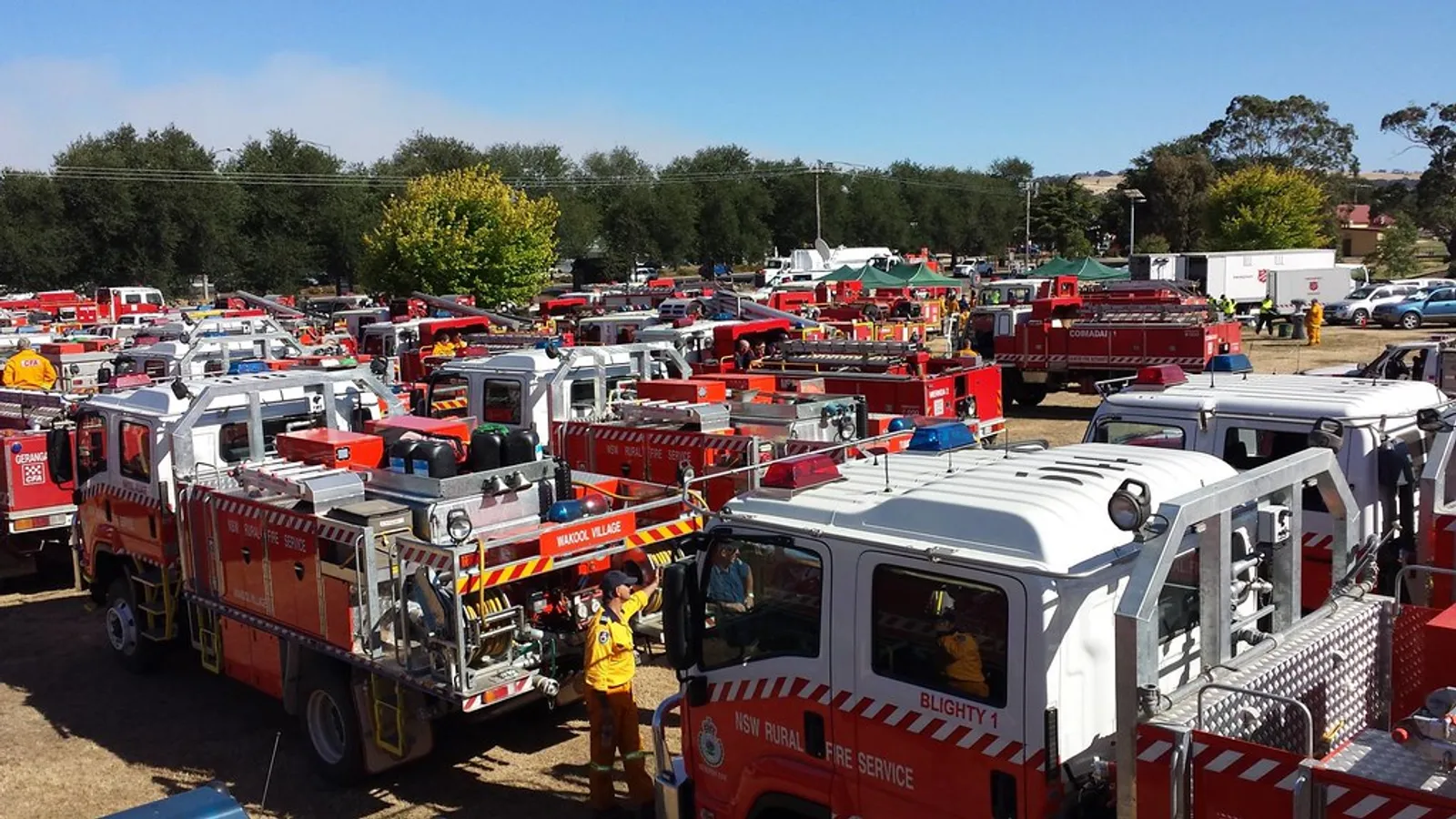
At 1am on Monday 5 October, the Fire Danger Period began in the Wellington and East Gippsland shires. CFA’s Chief Officer, Jason Heffernan, said conditions were “exceptionally dry” and put the start “two weeks earlier than the beginning of the 2025/26 fire season” (CFA, 2026a). Mildura is declared from 26 October and several councils in the state’s north from early November, while most municipalities on CFA’s own restriction table still read as having no restrictions in force (CFA, 2026b). Two shires at the start of October is not a season. It is, though, the stretch of the year when a resourcing question can still be answered on paper, and there is one that has been waiting since 2024.
Almost every part of Australian fire operations rests on the night giving something back. Shift and relief cycles are built around it. The standard tactic of working a flank after dark and consolidating by dawn depends on it. Aircraft come off task at last light, and the people who crewed them are expected to sleep. A seven-day resourcing picture assumes each night returns some ground. For as long as there have been organised crews, the assumption has been a reasonable one, because the physics underneath it is sound: temperatures drop overnight, humidity rises, fine fuels pick up moisture, and a fire that ran all afternoon slows down.
What has changed is how much relief that physics delivers, and the change has been measured. Balch et al. (2022) worked out, for each kind of land cover, the level of vapour pressure deficit below which fires are very rarely detected. They then counted the hours a year spent above that level, using global satellite records of day and night fire detections against hourly climate data. Daily minimum vapour pressure deficit rose by 25 per cent between 1979 and 2020. Across burnable lands, the annual number of flammable night-time hours rose by 110, which the authors translate as “allowing five additional nights when flammability never ceases”. Across nearly a fifth of burnable land, flammable nights increased by at least a week. Night fires became 7.2 per cent more intense between 2003 and 2020. The authors give the operational reading themselves: their results “reinforce the lack of night-time relief that wildfire suppression teams have experienced in recent years”.
The Australian mechanism was set out in a 2024 paper whose lead author is a fire-weather scientist with the Bureau of Meteorology. Peace and McCaw (2024) reviewed the atmospheric dynamics that drive fire behaviour during heatwaves, drawing on the 2019-20 season, and identified nocturnal low-level jets, deep unstable planetary boundary layers and fire-atmosphere coupling among the key processes at work. Theirs is a review and an argument built on observed events, and they are explicit that it describes conditions beyond what afternoon fire danger projections capture. The conclusion reads as a forecast of operating conditions: “long windows of multi-day fire events where overnight suppression is less effective and fire perimeters will expand continuously and aggressively over multiple days and nights”.
The paper does not stop at the meteorology. Greater overnight fire activity and multi-day events, the authors say, leave agencies “having to expand resourcing for overnight work” and “manage personnel fatigue”, with training revised so crews can identify the conditions that produce unusually active fire behaviour overnight. That is a resourcing instruction, published in an Australian journal in June 2024 and addressed to fire management agencies. I cannot find where anybody has costed it.
The closest thing to a field test ran last year in southwestern Europe. Resco de Dios et al. (2026) report nearly 700,000 hectares burnt in the Iberian Peninsula alone, and found that between 29 and 42 per cent of the fires they analysed spread faster at night than during the day, a pattern they call seldom reported. They attribute it to interactions between surface weather and atmospheric instability, with pyroconvection a possible third driver. The fuels and the suppression model there are not ours, so that range does not transfer to Australia, and the paper does not claim it does. Two other findings from that season reach further. The same authors conclude that rising intensity “likely facilitated the overwhelming of suppression efforts during simultaneous fire events that may have been manageable decades ago”. And the season was no local anomaly. Keeping et al. (2026) put European burnt area above 1.4 million hectares, the highest since the EU’s fire information system began recording in 2006, with Spain at 393,000 and Portugal at 279,000. They attribute the fire weather behind it mainly to rising vapour pressure deficit.
Read together, these findings put the binding constraint in the roster instead of the forecast. If a material share of fires runs harder after dark, better forecasting does not change what the roster can produce the following night. The question it leaves is how many crews a district can field on a second consecutive night and then a third, and what fatigue provisions require of those crews before they stand down. Prediction can tell an incident controller which night is going to be bad; the roster decides whether the crews to work it exist.
Aviation is the hardest part of this to count, and the easiest to get wrong. The National Aerial Firefighting Centre has for some years contracted helicopters “capable of working at night using Night Vision Goggles (NVG)”. Victoria’s night firebombing began as an Emergency Management Victoria trial around Ballarat in early 2018, run with the Civil Aviation Safety Authority. NAFC says the exercise “demonstrated that night firebombing could be a practical and effective tool”, and the work continued through later seasons. Alongside that, NAFC publishes a condition: until more experience is gained, “night firebombing will only occur on fires where the aircraft crew has operated during the day” (NAFC, n.d.). As a safety rule that is sensible. As a resourcing statement it says something harder to work around: the aircraft available after dark is crewed by people who have already flown that fire in daylight, inside the same duty limits. An agency that counts a night-capable aircraft as extra overnight effort has counted one crew twice.
The volunteer model has the same shape. Someone with a day job can usually give one night. What a seven-day resourcing picture needs to know is how many of those people will be there for the second night and the third, and what the week afterwards looks like in the towns those crews come from. I have argued before that borrowed capacity gets written into Australian resourcing submissions as capability held. This is the same accounting error one layer down, inside a single fire instead of across a hemisphere. Hours that have already been spent get counted as hours still available.
What this asks of an agency is counting, and October is when it can still be done. Before summer, a district can write down four numbers: how many crews it can put on a line for two consecutive nights, how many for three, how many aviation crew-days it holds against a multi-day event, and the point at which a fire running every night stops having a night shift. Each of those four numbers sits in rosters and aircraft contracts already. Nobody has needed the total before, and the agencies that work it out this month will be the ones that know, in January, which fires they can hold overnight and which they cannot.
References
- Balch, J. K., Abatzoglou, J. T., Joseph, M. B., Koontz, M. J., Mahood, A. L., McGlinchy, J., Cattau, M. E., & Williams, A. P. (2022). Warming weakens the night-time barrier to global fire. Nature, 602(7897), 442-448. https://doi.org/10.1038/s41586-021-04325-1
- Country Fire Authority. (2026a, September 29). Victorian fire season to officially begin. CFA News. https://news.cfa.vic.gov.au/victorian-fire-season-to-officially-begin
- Country Fire Authority. (2026b). Fire restriction dates. CFA. https://www.cfa.vic.gov.au/warnings-and-restrictions-2025/fire-danger-period/fire-restriction-dates
- Keeping, T. R., Zachariah, M., Haas, O., Grillakis, M., Barnes, C., Clay, G. D., Ekberzade, B., Jaupaj, O., Ribeiro, A., Trigo, R., Voulgarakis, A., & Otto, F. E. L. (2026). Attribution of the record breaking 2025 European fire season to climate change. Natural Hazards and Earth System Sciences, 26(8), 3761-3813. https://doi.org/10.5194/nhess-26-3761-2026
- National Aerial Firefighting Centre. (n.d.). Frequently asked questions. NAFC. https://nafc.org.au/faqs/
- Peace, M., & McCaw, L. (2024). Future fire events are likely to be worse than climate projections indicate: these are some of the reasons why. International Journal of Wildland Fire, 33, WF23138. https://doi.org/10.1071/WF23138
- Resco de Dios, V., Cunill Camprubí, À., Schütze, S. J., Castedo-Dorado, F., Picos, J., Ramírez, J., Domènech, R., Bachfischer, M., Castellnou Ribau, M., & Cardil, A. (2026). Record-breaking wildfire intensity and nocturnal spread during the extreme 2025 wildfire season in Southwestern Europe: Causes and impacts. Journal of Environmental Management, 418, 131063. https://doi.org/10.1016/j.jenvman.2026.131063