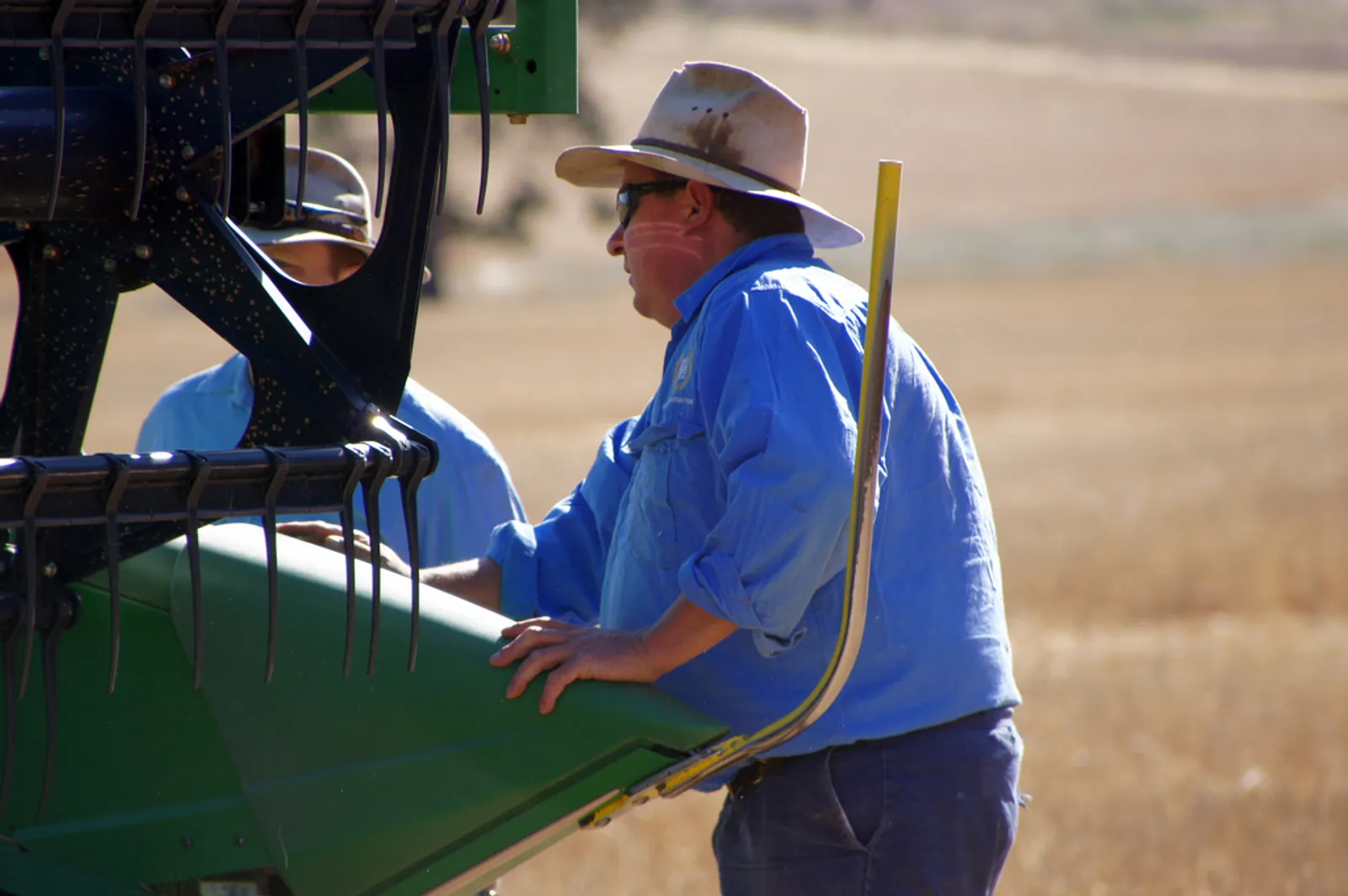
In late October, at a fire station in Natte Yallock in central Victoria, a CFA commander spent an evening writing down tankers. The session was District 2’s first for owners of private firefighting equipment, run under the Get Fire Ready 2026 banner, and the brigade laid on a barbecue. Local farmers and landowners were invited, with grain and hay contractors among them, to learn about operating private equipment at fires and to register what they own. Commander Hugh Kelly registered sixteen private firefighting tankers that night, and CFA reported enough interest to make another session likely (Country Fire Authority, 2026a). Two more were scheduled in the fortnight after, at Hunter-Diggora on 1 November and Maryborough on the 10th.
The agenda ran to eight items. Five were about the operator and the machine: vehicle readiness, working efficiently with suitable equipment, protective clothing, harvester and machinery operations, general fire awareness. Three were about the agency: working cooperatively with emergency services including fire-bombing aircraft, UHF channel 30, which District 2 uses on the fireground, and how to integrate a private tanker into the CFA operational plan (Country Fire Authority, 2026a). The season was closing in. In another CFA district, CFA declared on 5 November that the Fire Danger Period for Glenelg Shire would start at 1am on the 16th, after a three-month rainfall deficit that Assistant Chief Fire Officer Andrew Barry said was the lowest on record for much of it (Country Fire Authority, 2026b).
Private equipment is not a fringe activity in Victoria, and CFA does not describe it as one. Its standing page for private firefighting equipment says that when a fire starts on a farm it is often neighbours who arrive first on the scene to help put it out with their own equipment, and that private firefighting equipment is an essential part of the community’s response to fire. The same page records two obligations. Landowners operating machinery such as tractors and harvesters are legally required to carry firefighting equipment. During the Fire Danger Period a landowner or manager has a responsibility to extinguish unplanned fire on their property and to report it to Triple Zero (Country Fire Authority, 2026c).
What the same page offers in return is a single administrative artefact. To get private equipment through an emergency-services-only roadblock, the appliance needs a yellow CFA Private Firefighting Equipment Traffic Management Point Access sticker. To get one, the machine has to be in line with CFA’s guidelines for operating private equipment at fires, and the owner fills in an application form and returns it to the nearest district office. The page sets out no term for that sticker and no renewal, and does not use the word register at all. It says nothing about insurance or liability (Country Fire Authority, 2026c). A district commander writing sixteen tankers into a list is doing something that guidance does not mention.
Across the border the same question has a different answer. South Australia’s Country Fire Service requires all farm fire unit operators to be formally registered with it. Registration is open year round and lasts three years for anything submitted since January 2025. What the operator gets is itemised. The list runs from CFS resources and information through vehicle stickers that identify them to police at traffic management points, and ends with easier access to logistics support including meals and water resupply. The third item is insurance coverage for owner/operators and their equipment used in support of CFS during fires (SA Country Fire Service, 2026). Those pages do not describe the policy or its exclusions, and I have not read the handbook they link. Insurance is still named as a reason to register, which is more than Victoria offers.
New South Wales went at a third problem. In October 2025 it introduced conditional registration for farm firefighting vehicles, after trials of around 350 of them, so that a farm unit could lawfully be driven on a public road to a fire that is not on its owner’s land. Each one is inspected, registration is renewed annually, equipment must be permanently attached, and a unit may use roads up to 50 km from where it is garaged east of the Newell Highway, with no limit west of it. Applications go to Service NSW and not to the fire agency (NSW Government, 2025). The announcement says nothing about whether a registered vehicle is tasked by the Rural Fire Service or shows up in its resource tracking.
Three states, three things called registration, three different promises. One document in the set says what the promise actually rests on. The Rural Fire Service worked with farmers on guidelines for farm fire units on firegrounds (NSW Rural Fire Service, n.d.-b). That guide assumes that in some cases those operators will arrive at a fire before the RFS does (NSW Rural Fire Service, n.d.-a). Then it gets specific about cover. On what it takes to be covered by the relevant workers compensation scheme, the guide says it depends on the circumstances but requires more than just logging on. There must be active engagement with an RFS officer, and in most cases the operator will need to work within the RFS command and control structure. That requirement exists in respect of each incident, and the RFS cannot provide a standing consent to an operator.
Read that beside a sentence a few lines on. For non-members, the guide says, the scheme only applies when you are fighting a fire without remuneration or reward, voluntarily and without obligation, so cover generally will not be available on land you own or occupy, or in the course of your employment. The same guide then sets out the occupier’s duty under the Rural Fires Act 1997: on becoming aware of a fire during a bush fire danger period, take all possible steps to extinguish it, and report it if it cannot be put out without assistance (NSW Rural Fire Service, n.d.-a). I am describing one document, not drawing a legal conclusion, and this is New South Wales law. On the face of that guide, the duty to fight a fire on your own place and the protection for fighting one voluntarily do not meet. The farmer on their own paddock and the contractor on an hourly rate fall between them.
That is why the safety case matters more here than the capacity arithmetic. The same guide sets a shared expectation on operators and RFS members alike: focus on tasking lower risk activities to farm fire unit operators, given the absence of burn over protection. It asks operators to log off before leaving an incident, so that field commanders can account for personnel on the fireground in the event of special safety hazard warnings or adverse weather events. Knowing who is out there protects them before it informs anybody’s plan. It is what lets somebody warn them before a wind change.
The tempting conclusion is that a capability you have not registered is one you cannot plan around, so the first job is to count the private fleet. That is the cheap half. A register starts doing work at the point somebody decides what it entitles the registered party to, and the three schemes answer that differently: identification at a roadblock in Victoria, insurance in South Australia, road legality in New South Wales. I have looked before at how many crews a district can field on a second and third consecutive night, and at a fireground where the resources arrived ahead of the plan. Private units are part of both problems, and neither piece had anything to say about them.
The question CFA’s guidance leaves open is what an operator is owed when something goes wrong at somebody else’s fire.
References
- Country Fire Authority. (2026a, November 2). CFA works with owners of private firefighting equipment. CFA News. https://news.cfa.vic.gov.au/cfa-works-with-owners-of-private-firefighting-equipment
- Country Fire Authority. (2026b, November 5). Fire Danger Period declared early for Glenelg Shire. CFA News. https://news.cfa.vic.gov.au/fire-danger-period-declared-early-for-glenelg-shire
- Country Fire Authority. (2026c). Private fire fighting equipment. https://www.cfa.vic.gov.au/plan-prepare/private-fire-fighting-equipment
- NSW Government. (2025, October 1). Minns Labor Government extinguishes red tape with common sense reform for Farm Firefighting Vehicles [Ministerial release]. https://www.nsw.gov.au/ministerial-releases/minns-labor-government-extinguishes-red-tape-common-sense-reform-for-farm-firefighting-vehicles
- NSW Rural Fire Service. (n.d.-a). Farm Fire Unit operational guide. https://www.rfs.nsw.gov.au/__data/assets/pdf_file/0019/242713/FFU-Operational-Guide.pdf
- NSW Rural Fire Service. (n.d.-b). Farm fire safety. https://www.rfs.nsw.gov.au/plan-and-prepare/farm-fire-safety
- SA Country Fire Service. (2026). Farm fire units. https://www.cfs.sa.gov.au/plan-prepare/business-farms/farm-fire-units/